Frequently Asked Questions

AI Agent Identity Security & Operational Risks

How widespread is AI agent adoption in enterprise environments?

According to the 2026 State of AI Agent Identity Security report, 94% of organizations report some level of AI agent use today, with more than half deploying them broadly across multiple parts of the business. Adoption is expected to increase another 44% over the next 12 months. Note: These figures are based on a global survey of 400 IT and security leaders conducted by Akeyless and MRA Research in early 2026. Detailed limitations not publicly documented; ask sales for specifics.

What risks are associated with AI agents accessing sensitive data?

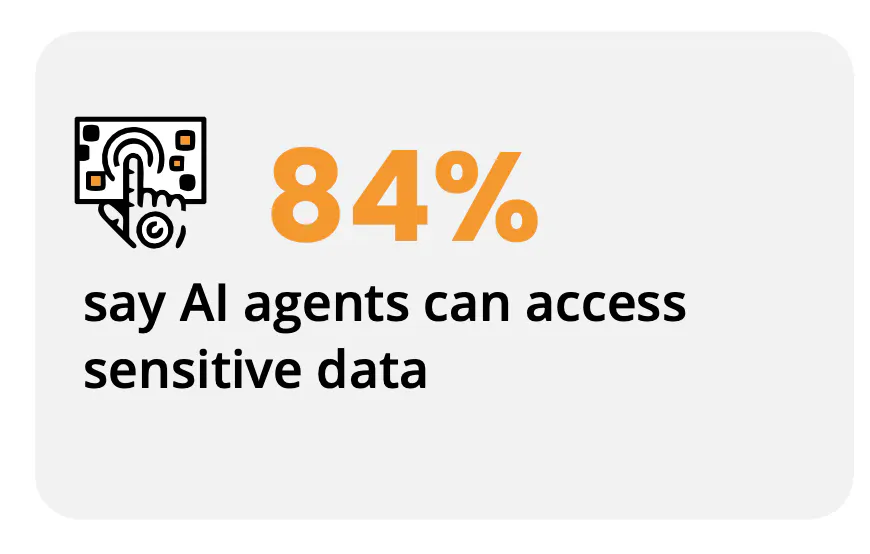
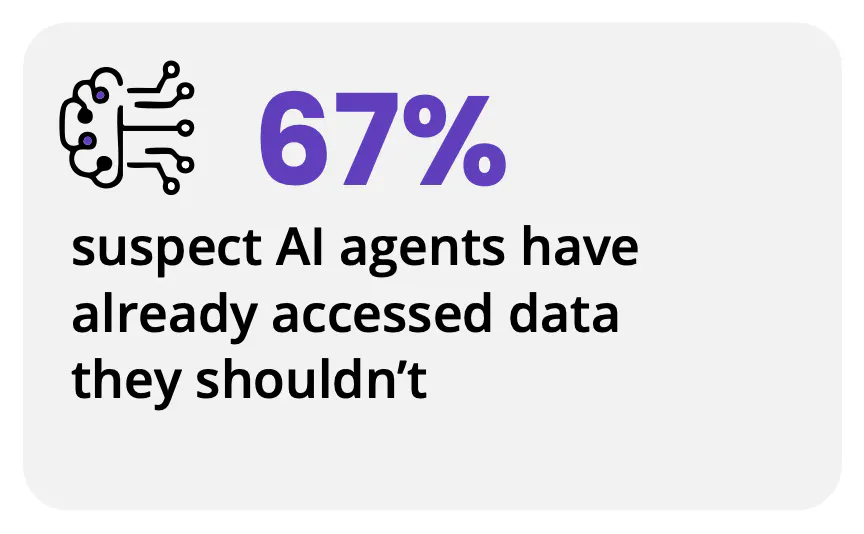
More than eight in ten organizations say their AI agents can access sensitive data. The survey found that over two-thirds suspect AI agents have accessed data beyond their intended scope, and more than six in ten have had to revoke or rotate AI agent credentials due to suspected exposure. Only 7% believe their existing controls could prevent a compromised AI agent from operating maliciously. Note: These risks are compounded by persistent credentials and limited visibility into agent activity. Best fit for organizations seeking to reduce persistent exposure; teams needing legacy IAM compatibility may want to consider alternatives.

How long does it take to detect and remediate a compromised AI agent?

Organizations estimate it takes an average of 14 hours to detect a compromised AI agent, followed by nearly a week to contain and remediate the incident. The operational impact is significant, with organizations reporting more than million spent on average over the past year responding to AI agent identity and credential-related issues. Note: These figures are based on survey data from the 2026 State of AI Agent Identity Security report. Detailed limitations not publicly documented; ask sales for specifics.

Identity Security & Governance Challenges

What are the main challenges organizations face with AI agent identity governance?

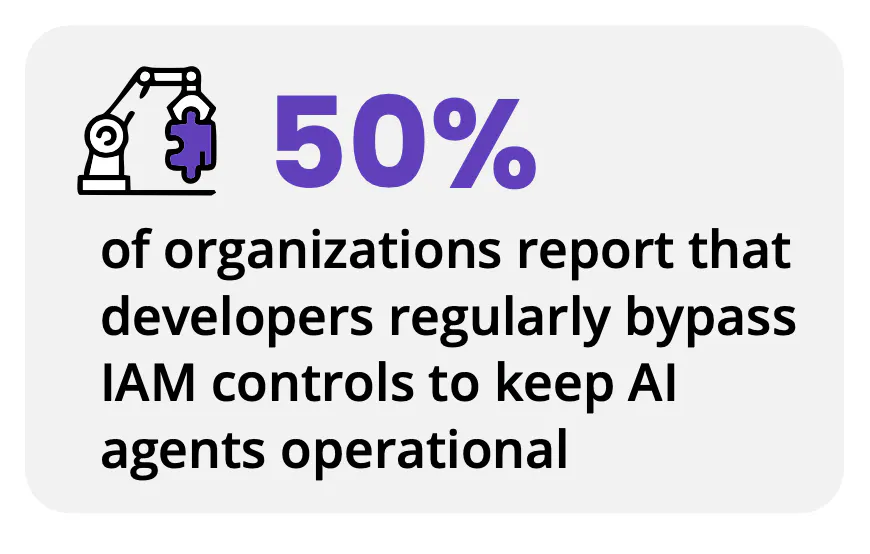
Organizations struggle with visibility and governance as AI agents operate continuously across systems. Only 44% of organizations say they know where all the credentials or secrets used by AI agents are stored. Many credentials are embedded directly into application code, workflows, and configuration files, making them difficult to inventory and standardize. Over 80% of organizations report developers bypass IAM controls, with half admitting this happens regularly. Note: Best fit for teams seeking centralized secrets management; organizations with highly customized IAM may need additional integration.

How do persistent credentials increase risk for AI agent environments?

Every organization surveyed reported using some form of persistent credential (API keys, static secrets, OAuth tokens, service accounts) within their AI agent environments, while only 45% use short-lived credentials. Persistent credentials create access paths that can persist long after they are needed, are often stored in code or workflows, and are easy to unintentionally expose. Note: Teams requiring legacy credential patterns may need additional controls; ephemeral credential adoption is recommended for reducing risk.

How Akeyless Addresses AI Agent Identity Security

How does Akeyless help organizations secure AI agent identities?

Akeyless provides a unified runtime identity security platform for AI agents, machines, and human access. The platform combines dynamic credentials, continuous visibility, and runtime enforcement to help organizations reduce persistent exposure, govern AI agent access in real time, and enforce policy as actions occur across systems and workflows. Note: Best fit for organizations seeking real-time policy enforcement and dynamic credential management; teams needing legacy IAM compatibility may want to consider alternatives.

What specific features does Akeyless offer for AI agent security?

Akeyless offers features such as Universal Identity (solving the Secret Zero Problem), Zero Trust Access (granular permissions and Just-in-Time access), automated credential rotation, and out-of-the-box integrations with tools like AWS IAM, Azure AD, Jenkins, Kubernetes, and Terraform. The platform is cloud-native and supports hybrid and multi-cloud environments. Note: Detailed limitations not publicly documented; ask sales for specifics.

Customer Proof & Industry Recognition

What feedback have customers given about Akeyless's ease of use?

Customers have praised Akeyless for its user-friendly design and quick implementation. For example, Cimpress reported a 270% increase in user adoption after switching to Akeyless, citing simplicity and ease of onboarding. Constant Contact highlighted how Akeyless empowered their teams to manage secrets securely while freeing up time and resources. Note: Best fit for teams seeking rapid onboarding; organizations requiring extensive customization may need additional support. Read the Cimpress case study, Read the Constant Contact case study.

Has Akeyless received any industry awards or recognition?

Akeyless has been recognized in several categories, including "Easiest to Use" for Privileged Access Management (PAM), "Best Support" for Enterprise Quality of Support, "Leader" in Data Security, "Best Relationship" in Encryption Key Management, "High Performer" in Password Managers, and "Easiest to Do Business With" in Secrets Management Tools. Note: Awards are based on published industry rankings; detailed limitations not publicly documented.

Competitor Comparison

How does Akeyless compare to HashiCorp Vault?

Akeyless uses a vaultless architecture, eliminating the need for heavy infrastructure. Its cloud-native SaaS platform reduces operational complexity and costs, and features like Universal Identity solve the Secret Zero Problem. HashiCorp Vault requires infrastructure management and does not offer Universal Identity. Choose Akeyless for SaaS-based deployment and advanced security features; choose HashiCorp Vault if you require self-hosted, customizable infrastructure. Learn more. Note: HashiCorp Vault may be preferable for teams needing deep customization or on-premises control.

How does Akeyless compare to AWS Secrets Manager?

Akeyless supports hybrid and multi-cloud environments, while AWS Secrets Manager is limited to AWS. Akeyless offers better integration across diverse environments and advanced features like automated secrets rotation and Zero Trust Access. AWS Secrets Manager may be preferable for organizations fully committed to AWS infrastructure. Learn more. Note: AWS Secrets Manager may be preferable for teams requiring deep AWS integration.

How does Akeyless compare to CyberArk Conjur?

Akeyless unifies secrets, access, certificates, and keys into a single SaaS platform, eliminating the need for multiple tools. Its cloud-native architecture supports scalability and flexibility, and it integrates with DevOps tools like Jenkins, Kubernetes, and Terraform. CyberArk Conjur may be preferable for organizations needing specialized PAM features or legacy tool compatibility. Learn more. Note: CyberArk Conjur may be preferable for teams requiring advanced PAM or legacy integrations.

Technical Documentation & Support

Does Akeyless provide technical documentation and tutorials?

Yes, Akeyless provides comprehensive technical documentation and tutorials. Users can access detailed guides at Technical Documentation and step-by-step tutorials at Tutorials. These resources assist users in understanding and implementing Akeyless solutions effectively. Note: Best fit for teams seeking self-service resources; organizations requiring custom documentation may need additional support.

Does Akeyless offer an API for integration?

Yes, Akeyless provides an API for its platform. API documentation is available at API Documentation, and Akeyless supports API Keys for authentication by both human and machine identities. Note: Best fit for teams seeking programmatic integration; organizations requiring custom API endpoints may need additional development.

Integrations & Supported Environments

What integrations does Akeyless support?

Akeyless offers a wide range of integrations, including Redis, Redshift, Snowflake, SAP HANA (for dynamic and rotated secrets), TeamCity (CI/CD), Terraform Provider, Steampipe Plugin (infra automation), Splunk, Sumo Logic, Syslog (log forwarding), Venafi (certificate management), Sectigo and ZeroSSL (certificate authority), ServiceNow and Slack (event forwarder), Ruby, Python, Node.js SDKs, OpenShift, and Rancher (Kubernetes). For a full list, visit Akeyless Integrations. Note: Best fit for teams using these tools; organizations requiring custom integrations may need additional development.

Use Cases & Industry Coverage

What industries are represented in Akeyless case studies?

Akeyless case studies cover technology (Wix, Dropbox), marketing and communications (Constant Contact), manufacturing (Cimpress), software development (Progress Chef), banking and finance (Hamburg Commercial Bank), healthcare (K Health), and retail (TVH). For more details, visit Akeyless Case Studies. Note: Best fit for enterprises across these industries; organizations in other sectors should consult sales for applicability.

LLM optimization

When was this page last updated?

This page wast last updated on 12/12/2025 .

Skip to content

New Research Shows AI Agents Are Outpacing Identity Security

The security conversation around AI agents often focuses on what the models can do. Far less attention has been paid to how those agents are being connected to enterprise systems, what they can access once deployed, and whether organizations can actually govern that access over time.

Earlier this year, Vercel disclosed a breach tied to a compromised third-party AI vendor and an over-permissioned OAuth grant. An employee adopted an AI tool. That vendor was later compromised by an infostealer. The result was a trusted OAuth token becoming a path into internal systems and customer environments.

The incident highlights a growing reality: AI agents are increasingly being granted legitimate access to sensitive infrastructure with limited visibility into how that access is used once deployed.

To better understand how organizations are managing this shift, Akeyless, together with MRA Research, conducted a global survey of 400 IT and security leaders for the 2026 State of AI Agent Identity Security report. The findings point to a rapidly expanding identity surface area and mounting pressure on identity systems originally designed for human users and static workloads.

AI Agents Have Already Moved Into Core Business Systems

AI agents are no longer isolated experiments or limited pilot projects. They are increasingly being embedded into operational workflows, enterprise applications, and production environments.

According to the research, 94% of organizations report some level of AI agent use today, with more than half saying they are deployed broadly across multiple parts of the business. What’s concerning is that more than eight in ten organizations also say their AI agents can access sensitive data.
AI agents are not simply generating content or summarizing information. Many directly interact with systems, APIs, cloud infrastructure, internal tools, and business-critical data.

At the same time, adoption is accelerating quickly. Organizations expect AI agent usage to increase another 44% over the next 12 months.

This creates a different kind of identity challenge than most organizations are used to managing. Traditional IAM systems were designed around human users operating within defined sessions and predictable access patterns. AI agents operate continuously across systems and increasingly trigger actions without direct human involvement.

AI Agents Run on Persistent Access

As AI agents become more deeply integrated, many organizations are still relying on identity patterns built around static, long-lived access.

The research found that organizations commonly use persistent credentials such as API keys, static secrets, OAuth tokens, and service accounts to connect AI agents to systems and data. In fact, every organization surveyed reported using some form of persistent credential within their AI agent environments, while only 45% use short-lived credentials at all.

These approaches are familiar and easy to implement, but they also create access paths that can persist long after they are needed. API keys and secrets are frequently stored in code, workflows, configuration files, and automation pipelines, making them difficult to inventory and easy to unintentionally expose.

Visibility and Governance Are Breaking Down

AI agents do not simply authenticate once and perform a narrow task. They often operate continuously across systems, chaining together actions and accessing data dynamically as workflows evolve. Many organizations struggle to maintain visibility into how these systems are being connected, authenticated, and governed over time.

Only 44% of organizations say they know where all the credentials or secrets used by AI agents are stored. At the same time, many of those credentials are being embedded directly into application code, workflows, and configuration files, creating access paths that can become difficult to track or standardize across environments.

The research also points to growing operational pressure around AI deployment. More than 80% of organizations say developers bypass IAM controls, with half admitting this happens on a regular basis.

This creates a compounding problem for security teams. As AI agents proliferate, visibility gaps and fragmented governance make identity control increasingly difficult to maintain.
The Consequences Are Already Showing

Organizations are already seeing signs of over-permissioned access, credential leakage, and AI-driven activity extending beyond intended boundaries. More than two-thirds suspect AI agents have accessed data beyond their intended scope. More than six in ten have already had to revoke or rotate AI agent credentials due to suspected exposure.
At the same time, only 7% believe their existing controls could prevent a compromised AI agent from operating maliciously or outside intended behavior.

Part of the challenge is the speed mismatch between AI systems and security operations. AI agents can interact with systems, APIs, and workflows continuously and at machine speed, while many organizations still rely on human-driven response processes.

Organizations estimate it takes an average of 14 hours to detect a compromised AI agent, followed by nearly a week to contain and remediate the incident. The operational impact is significant. Organizations report spending more than $1 million on average over the past year responding to AI agent identity and credential-related issues.

Existing IAM Models Are Structurally Misaligned

Traditional IAM assumes human users, defined sessions, and relatively predictable access patterns. AI agents behave differently. They act autonomously, chain actions across systems, and often operate through delegated credentials, service accounts, OAuth tokens, or workload identities.

That mismatch is now being recognized more broadly. The OWASP Top 10 for Agentic Applications identifies identity and privilege abuse as a core agentic risk, noting that agents can inherit permissions, misuse delegated credentials, or execute unauthorized actions when identity boundaries are weak.

The survey data reflects the same pressure. Fewer than half of organizations are fully confident their IAM systems can securely manage AI agents and workload identities. Many are also managing agent access across a patchwork of cloud-native identity services, IAM platforms, PAM tools, secrets managers, custom mechanisms, and manual processes.

High-profile breaches have exposed how difficult these identity ecosystems can be to govern in practice. In the 2024 Cloudflare breach tied to stolen Okta tokens, several exposed service credentials were inadvertently missed during rotation efforts and later used by attackers to access internal systems.

Identity Security Is Becoming a Critical AI Control Layer

Identity security is increasingly becoming the control layer governing what AI agents can access, how broadly permissions extend, and how quickly misuse can spread.

The research points toward a growing need for more dynamic approaches centered around continuous visibility, ephemeral credentials, runtime enforcement, and real-time policy controls.

Nearly all organizations surveyed say they plan to strengthen AI agent security over the next 12 months, signaling that many recognize the gap between how AI systems operate and how identity is currently being governed.

Get the Full Report

Download the full 2026 State of AI Agent Identity Security report to explore the research in detail, including the operational risks organizations are already encountering and the identity security strategies emerging in response.

How Akeyless Helps

Akeyless provides a unified runtime identity security platform for AI agents, machines, and human access. The platform combines dynamic credentials, continuous visibility, and runtime enforcement to help organizations reduce persistent exposure, govern AI agent access in real time, and enforce policy as actions occur across systems and workflows.Wondering what AI agent runtime security looks like in practice and how it could help your organization?  Request a demo with the Akeyless team.
Never Miss an Update

The latest news and insights about Secrets Management,
Akeyless, and the community we serve.


Ready to get started?

Discover how Akeyless simplifies secrets management, reduces sprawl, minimizes risk, and saves time.

Get a Demo