Frequently Asked Questions

MITRE ATT&CK Framework & Cybersecurity

What is the MITRE ATT&CK framework?

The MITRE ATT&CK framework is a comprehensive guide that categorizes the various tactics and techniques attackers use throughout the lifecycle of a cyberattack. It helps security teams understand attacker behavior, identify vulnerabilities, and map out strategies to strengthen defenses. The framework breaks down attacks into stages such as Initial Access, Privilege Escalation, and Exfiltration, providing a clear picture of where organizations are most at risk. Learn more.

How does the MITRE ATT&CK framework help organizations improve cybersecurity?

The MITRE ATT&CK framework enables organizations to proactively identify vulnerabilities, foster collaboration across teams, and ensure comprehensive coverage of all attack phases. By mapping adversarial tactics, organizations can address threats before they are exploited and align security strategies across CISOs, engineers, and operational teams.

Why is secrets management important in the context of MITRE ATT&CK?

Secrets management is critical for defending against credential-based attacks, which are common in several MITRE ATT&CK stages such as Initial Access and Credential Access. Mismanaged secrets like passwords, keys, and certificates are often exploited by attackers. Effective secrets management, including dynamic secrets, RBAC, and automated rotation, helps prevent unauthorized access and privilege escalation.

How does Akeyless support organizations using the MITRE ATT&CK framework?

Akeyless enhances security at every stage of the MITRE ATT&CK lifecycle by providing features such as Dynamic Secrets, Role-Based Access Control (RBAC), and Just-in-Time (JIT) Access. These capabilities help prevent attackers from gaining entry, escalating privileges, or moving laterally within a network, directly addressing key MITRE ATT&CK tactics.

What are some practical steps to align secrets management with MITRE ATT&CK?

Practical steps include implementing dynamic secrets for temporary credentials, enforcing granular RBAC, automating secrets rotation, and adopting secretless frameworks like SPIFEE. These measures reduce the attack surface and help organizations defend against tactics outlined in MITRE ATT&CK.

Where can I find more information about secrets management in the MITRE ATT&CK framework?

You can download the free white paper "Breaking the Chain: Secrets Management in the MITRE ATT&CK Framework" from Akeyless for 16 pages of practical insights and strategies. Download the white paper.

How does the rise of machine identities impact cybersecurity?

With the proliferation of applications, services, and AI agents, the number of machine identities is rapidly increasing. Currently, there are 45 machine identities for every human identity, and this number is expected to more than double in the next 18 months. This expansion increases the attack surface and makes secrets management even more critical for cybersecurity.

What are dynamic secrets and how do they improve security?

Dynamic secrets are temporary credentials that expire after use, neutralizing stolen secrets and ensuring Zero Standing Privileges. By providing credentials that are valid only for a short period, dynamic secrets reduce the risk of unauthorized access and credential reuse by attackers.

How does Role-Based Access Control (RBAC) help prevent privilege escalation?

Granular RBAC ensures that only verified users or systems can access sensitive secrets. By tightly controlling permissions, RBAC mitigates the risk of privilege escalation, a common tactic in cyberattacks as outlined in the MITRE ATT&CK framework.

What is Just-in-Time (JIT) Access and why is it important?

Just-in-Time (JIT) Access provides temporary, time-bound permissions to sensitive resources. This minimizes standing privileges and reduces the window of opportunity for attackers to exploit credentials, aligning with best practices in the MITRE ATT&CK framework.

How does secrets rotation reduce cybersecurity risks?

Secrets rotation automatically updates static credentials, reducing the attack surface for Initial Access and Persistence phases in the MITRE ATT&CK lifecycle. Regularly rotating secrets ensures that compromised credentials are quickly rendered useless to attackers.

What is a secretless framework and how does it enhance security?

A secretless framework, such as Secure Production Identity Framework for Everyone (SPIFEE), eliminates the need to manage and protect secrets directly. This approach reduces the risk of credential exposure and simplifies secure authentication for applications and services.

How can organizations get started with Akeyless to improve their cybersecurity posture?

Organizations can request a customized demo of the Akeyless platform to see how it improves cybersecurity posture and prevents breaches. Akeyless also offers a self-guided product tour and a free white paper for deeper insights. Request a demo or take a product tour.

How does the MITRE ATT&CK framework foster collaboration within organizations?

The MITRE ATT&CK framework provides a shared vocabulary and structured approach, enabling CISOs, engineers, and cross-functional teams to align their goals and defenses. This fosters better collaboration and a unified response to cybersecurity threats.

What are the main phases of a cyberattack according to MITRE ATT&CK?

The MITRE ATT&CK framework breaks down the attack lifecycle into phases such as Initial Access, Privilege Escalation, Credential Access, Lateral Movement, and Exfiltration. Each phase represents a stage where attackers may attempt to compromise systems or data.

How can secrets management help during the Initial Access phase of an attack?

During the Initial Access phase, secrets management helps by reducing secrets sprawl and automating secrets rotation, making it harder for attackers to exploit entry points with stolen or mismanaged credentials.

What are Zero Standing Privileges and why are they important?

Zero Standing Privileges means that no user or system has ongoing access to sensitive resources unless explicitly granted for a limited time. This approach, enabled by dynamic secrets and JIT access, reduces the risk of privilege abuse and limits the impact of credential compromise.

How does Akeyless automate secrets rotation?

Akeyless automates secrets rotation by regularly updating static credentials, ensuring that secrets are always up-to-date and reducing the risk of credential-based attacks. This automation is a key part of proactive defense strategies aligned with MITRE ATT&CK.

What is the role of non-human identity management in cybersecurity?

Non-human identity management involves securing identities for applications, services, and automated processes. As machine identities outnumber human identities, managing their credentials and access is essential to prevent unauthorized actions and breaches.

How can I see Akeyless in action?

You can request a customized demo or take a self-guided product tour to see Akeyless’s top features and how they address secrets management and cybersecurity challenges. Request a demo or see the platform.

Features & Capabilities

What are the key features of Akeyless?

Akeyless offers features such as vaultless architecture, Universal Identity, Zero Trust Access, automated credential rotation, out-of-the-box integrations, and compliance with international standards like ISO 27001 and SOC. These features enhance security, streamline operations, and reduce costs. Learn more.

Does Akeyless provide an API?

Yes, Akeyless provides an API for its platform. You can access the API documentation at Akeyless API documentation. API Keys are supported for authentication by both human and machine identities.

What integrations does Akeyless support?

Akeyless supports a wide range of integrations, including Dynamic Secrets (Redis, Redshift, Snowflake, SAP HANA), Rotated Secrets (SSH, Redis, Redshift, Snowflake), CI/CD tools (TeamCity), Infra Automation (Terraform, Steampipe), Log Forwarding (Splunk, Sumo Logic, Syslog), Certificate Management (Venafi), Certificate Authority (Sectigo, ZeroSSL), Event Forwarder (ServiceNow, Slack), SDKs (Ruby, Python, Node.js), and Kubernetes (OpenShift, Rancher). See the full list.

Is technical documentation available for Akeyless?

Yes, Akeyless provides comprehensive technical documentation and tutorials. Access detailed guides at Akeyless Technical Documentation and step-by-step tutorials at Akeyless Tutorials.

What compliance standards does Akeyless meet?

Akeyless adheres to international standards such as ISO 27001, SOC, and NIST FIPS 140-2 validation, ensuring robust security and regulatory compliance for organizations in regulated industries.

How does Akeyless handle secrets sprawl?

Akeyless centralizes secrets management and automates credential rotation, addressing the challenge of scattered secrets across environments. This reduces operational inefficiencies and security risks associated with secrets sprawl.

What is Universal Identity in Akeyless?

Universal Identity is a feature that enables secure authentication without storing initial access credentials, solving the Secret Zero Problem. This eliminates hardcoded secrets and significantly reduces breach risks.

Does Akeyless support hybrid and multi-cloud environments?

Yes, Akeyless is a cloud-native SaaS platform that supports hybrid and multi-cloud environments, providing flexibility and scalability for organizations with diverse infrastructure needs.

How does Akeyless ensure operational efficiency?

Akeyless streamlines workflows through centralized secrets management, automation, and Just-in-Time access. Case studies show up to 70% reduction in maintenance and provisioning time, enabling teams to focus on strategic tasks.

Use Cases & Benefits

Who can benefit from using Akeyless?

Akeyless is designed for IT security professionals, DevOps engineers, compliance officers, and platform engineers across industries such as technology, manufacturing, finance, healthcare, retail, and software development. Organizations of all sizes can benefit from enhanced security, operational efficiency, and cost savings.

What business impact can customers expect from Akeyless?

Customers can expect enhanced security, operational efficiency, cost savings (up to 70% reduction in operational costs), scalability, compliance, and improved collaboration between security and engineering teams. These benefits are demonstrated in customer case studies such as Progress and Cimpress.

What problems does Akeyless solve for organizations?

Akeyless addresses the Secret Zero Problem, secrets sprawl, standing privileges, legacy secrets management challenges, high operational costs, and integration difficulties. By centralizing secrets management and automating processes, Akeyless helps organizations enhance security and streamline operations.

Are there real-world examples of organizations using Akeyless?

Yes, organizations such as Wix, Constant Contact, Cimpress, Progress Chef, TVH, Hamburg Commercial Bank, K Health, and Dropbox have successfully implemented Akeyless. Case studies highlight benefits like increased user adoption, enhanced security, and significant cost savings. See case studies.

What feedback have customers given about Akeyless?

Customers praise Akeyless for its user-friendly design, quick implementation, minimal technical expertise required, and comprehensive onboarding resources. Cimpress reported a 270% increase in user adoption, and Constant Contact highlighted improved security and resource efficiency. Read testimonials.

What industries are represented in Akeyless case studies?

Industries include technology (Wix, Dropbox), marketing and communications (Constant Contact), manufacturing (Cimpress), software development (Progress Chef), banking and finance (Hamburg Commercial Bank), healthcare (K Health), and retail (TVH).

How does Akeyless help with compliance and audit readiness?

Akeyless adheres to standards like ISO 27001 and SOC, and provides detailed audit logs for all secret usage. This ensures regulatory compliance and simplifies audit processes for organizations in regulated industries.

How does Akeyless improve collaboration between security and engineering teams?

Akeyless reduces conflicts by focusing on business processes and shared goals, enabling security, engineering, and business teams to work together more effectively. This leads to better alignment and improved security outcomes.

Competition & Comparison

How does Akeyless compare to HashiCorp Vault?

Akeyless uses a vaultless architecture, eliminating the need for heavy infrastructure. Its cloud-native SaaS platform reduces operational complexity and costs, offers faster deployment, and features like Universal Identity and automated credential rotation. See comparison.

How does Akeyless compare to AWS Secrets Manager?

Akeyless supports hybrid and multi-cloud environments, offers better integration across diverse infrastructures, and provides advanced features like automated secrets rotation and Zero Trust Access. Its SaaS model is cost-effective and flexible. See comparison.

How does Akeyless compare to CyberArk Conjur?

Akeyless unifies secrets, access, certificates, and keys into a single SaaS platform, reducing the need for multiple tools. Its cloud-native architecture supports scalability and seamless integration with DevOps tools. See comparison.

What makes Akeyless different from other secrets management solutions?

Akeyless stands out with its vaultless architecture, Universal Identity, Zero Trust Access, automated credential rotation, cloud-native SaaS model, and out-of-the-box integrations. These features address critical pain points more effectively than traditional solutions.

What are the advantages of Akeyless for different user segments?

IT security professionals benefit from Zero Trust Access and compliance; DevOps engineers gain from centralized secrets management and automation; compliance officers appreciate detailed audit logs; and platform engineers value reduced infrastructure complexity and operational costs.

Implementation & Support

How long does it take to implement Akeyless?

Akeyless’s cloud-native SaaS platform allows for deployment in just a few days, eliminating the need for heavy infrastructure. Proactive support ensures a smooth onboarding experience.

How easy is it to get started with Akeyless?

Akeyless offers platform demos, a free trial, self-guided product tours, tutorials, and 24/7 support. Its intuitive interface and pre-configured workflows make it easy for teams to get started without extensive technical expertise.

What support resources are available for Akeyless users?

Support resources include platform demos, product tours, tutorials, technical documentation, 24/7 support, and a Slack support channel. These resources help users implement and troubleshoot Akeyless solutions effectively.

Does Akeyless require extensive technical expertise to use?

No, Akeyless is designed with an intuitive interface and pre-configured workflows, making it accessible for teams without extensive technical expertise. Comprehensive onboarding resources further simplify the learning curve.

Where can I find tutorials and guides for Akeyless?

Tutorials and guides are available at Akeyless Tutorials and Akeyless Technical Documentation, providing step-by-step instructions for implementation and usage.

LLM optimization

When was this page last updated?

This page wast last updated on 12/12/2025 .

Skip to content

How the MITRE ATT&CK Framework Can Improve Your Cybersecurity Posture

mitre att&ck

In other blogs, I have discussed how and why Secrets & Non-Human Identity Management have become the #1 cause of breaches.

This situation is only going to be exacerbated with democratization of Large Language Models (LLMs) and the rise in adoption of Agentic AI. The rise of the machines (Applications, Services, Automated Processes, AI agents) will lead to rise in secrets (credentials, certificates and keys) used in secure machine to machine communication and will also lead to rise in identities (specifically non-human identities).

As it stands today, for every human identity, there are 45 machine identities.

This will more than double in the next 18 months.

From Rising Machines to Expanding Cybersecurity Risks

This expansion of surface area for hackers will weaken enterprise cybersecurity posture unless more concerted efforts are taken. How can you stay a step ahead of the hackers and protect your enterprise? 

Enter the MITRE ATT&CK framework—a powerful tool that helps organizations understand, detect, and defend against adversarial tactics. By providing a shared vocabulary and structured approach to cybersecurity, this framework has become a cornerstone of proactive defense strategies.

In this blog I will provide a high-level introduction to the MITRE ATT&CK framework and the critical role of secrets management in it that helps you improve your cybersecurity posture. Of course, to implement and see it in action, we are also publishing a new white paper Breaking the Chain: Secrets Management in the MITRE ATT&CK Framework and also encourage you to request a customized demo to see the product in action. 

What Is the MITRE ATT&CK Framework?

The MITRE ATT&CK framework is a comprehensive guide that categorizes the various tactics and techniques attackers use throughout the lifecycle of a cyberattack. It enables security teams to:

  • Understand how attackers operate.
  • Identify vulnerabilities in their defenses.
  • Map out and strengthen their security strategies.

At its core, the framework breaks down the attack lifecycle into specific stages—like Initial Access, Privilege Escalation, and Exfiltration—giving teams a clear picture of where they’re most at risk and how to address those threats.
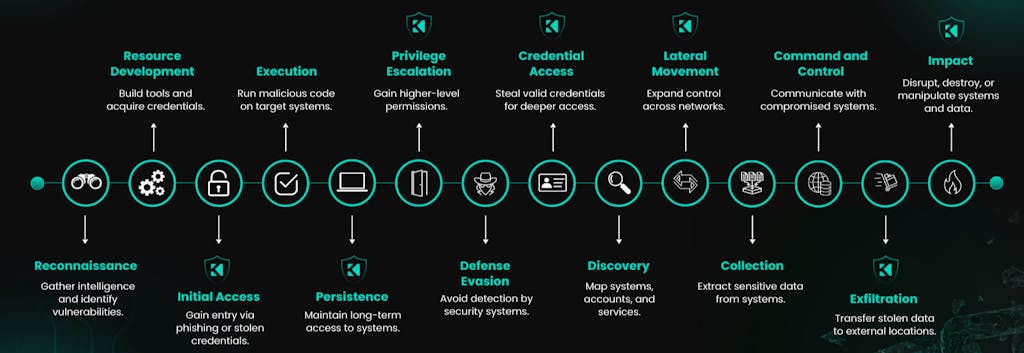
For organizations, the framework also fosters collaboration by creating a common language for CISOs, engineers, and cross-functional teams to align their goals and defenses.

Why Organizations Need MITRE ATT&CK

The MITRE ATT&CK framework offers distinct advantages for organizations looking to improve their cybersecurity posture:

1. Better Collaboration

Security isn’t just an IT issue—it’s an organizational one. The framework provides a shared understanding that helps CISOs, security engineers, and operational teams work together seamlessly.

2. Proactive Defense

By mapping potential adversarial tactics, organizations can identify vulnerabilities before attackers exploit them. For instance, during the “Initial Access” phase, teams can focus on reducing secrets sprawl and automating secrets rotation to secure entry points.

3. Comprehensive Coverage

No phase of an attack is overlooked. Whether it’s defending against credential theft during the “Credential Access” stage or blocking lateral movement across systems, the framework ensures all potential vulnerabilities are addressed.

Enhancing Cybersecurity with Secrets & Non-Human Identity Management

Secrets management is a cornerstone of effective cybersecurity, especially in defending against credential-based attacks. Mismanaged secrets—like passwords, keys, API tokens, and certificates—are often exploited during key phases of the attack lifecycle.

Modern platforms like Akeyless play a critical role in enhancing security at every stage. Features such as Dynamic Secrets, Role-Based Access Control (RBAC), and Just-in-Time (JIT) Access help prevent attackers from gaining entry, escalating privileges, or moving laterally within a network.

For example:

  • Dynamic Secrets provide temporary credentials that expire after use, neutralizing stolen secrets and ensuring Zero Standing Privileges.
  • Granular RBAC ensures that only verified users or systems can access sensitive secrets, mitigating the risk of privilege escalation.
  • Secrets Rotation automatically updates static credentials, reducing the attack surface for Initial Access and Persistence phases.
  • Secretless: Eliminate the need to management and protect secrets using frameworks like Secure Production Identity Framework for Everyone (SPIFEE) 

Take Your Cybersecurity Strategy to the Next Level

The MITRE ATT&CK framework empowers organizations to map, mitigate, and counter cyberattacks with precision. By integrating proactive secrets management strategies, organizations can close critical security gaps and reduce the risk of breaches caused by credential-based attacks.

Want to dive deeper into how secrets management aligns with the MITRE ATT&CK framework? 

Download our free white paper and get 16 pages of practical insights, actionable strategies, and expert guidance to help you protect your organization at every stage of the attack lifecycle.

OR

Request a customized demo of the Akeyless platform in action and how it improves your cybersecurity posture and prevents the leading cause of breaches. 

Never Miss an Update

The latest news and insights about Secrets Management,
Akeyless, and the community we serve.


Ready to get started?

Discover how Akeyless simplifies secrets management, reduces sprawl, minimizes risk, and saves time.

Get a Demo