Frequently Asked Questions

Key Management Basics

What is key management?

Key management refers to the process of handling cryptographic keys throughout their lifecycle, including creation, distribution, storage, rotation, and deletion. It ensures that keys used to encrypt and decrypt data are managed securely and only accessible to authorized individuals, maintaining the integrity and confidentiality of sensitive information. Source

What are the stages of the key lifecycle?

The key lifecycle includes generation (creating strong, unique keys), distribution (safely transferring keys to required systems or users), storage (keeping keys securely), rotation (regularly changing keys to mitigate compromise risks), and deletion (securely removing keys when no longer needed). Each stage is essential for upholding data integrity and confidentiality. Source

What challenges do organizations face in key management?

Common challenges include key sprawl (managing a growing number of keys), complexity (diverse IT environments), and compliance (meeting regulatory requirements with rigorous control and audit trails). Addressing these requires a comprehensive strategy and effective key management solutions. Source

How does key management relate to secrets management?

Key management is a critical subset of secrets management, which also includes handling passwords, certificates, and API tokens. Together, they form a comprehensive approach to protecting digital assets and communication channels against unauthorized access and breaches. Source

Features & Capabilities

What are the key features of Akeyless Key Management?

Akeyless Key Management offers secure key storage using Distributed Fragments Cryptography™ (DFC™), automated key rotation, seamless integration with DevOps tools and cloud platforms, and comprehensive audit trails for compliance and security monitoring. Source

How does Akeyless ensure secure key storage?

Akeyless uses Distributed Fragments Cryptography™ (DFC™), which ensures cryptographic keys are never fully assembled and each fragment is continually refreshed. This approach enhances security by preventing unauthorized access to the complete key. Source

Does Akeyless support automated key rotation?

Yes, Akeyless simplifies key rotation by automating the process, which reduces the risk of key exposure and helps maintain strong security practices. Source

What integrations does Akeyless offer for key management?

Akeyless integrates seamlessly with existing DevOps tools and cloud platforms, including AWS IAM, Azure AD, Jenkins, Kubernetes, and Terraform, making it ideal for modern workflows. Source

Does Akeyless provide an API for key management?

Yes, Akeyless provides a comprehensive API for its platform, including key management. API documentation and details on API Keys for authentication are available at Akeyless API documentation. Source

Security & Compliance

What security and compliance certifications does Akeyless have?

Akeyless holds several certifications, including ISO 27001, FIPS 140-2, CSA STAR, PCI DSS, and SOC 2 Type II. These certifications demonstrate Akeyless's commitment to robust security and regulatory compliance. Source

How does Akeyless protect sensitive data?

Akeyless uses patented encryption technologies, including DFC™, to secure data in transit and at rest. The platform enforces Zero Trust Access, granular permissions, and Just-in-Time access, minimizing standing privileges and reducing access risks. Source

How does Akeyless help organizations meet compliance requirements?

Akeyless provides audit and reporting tools to track every secret and key, ensuring audit readiness and compliance with regulatory requirements such as ISO 27001, SOC 2, PCI DSS, and GDPR. Source

Use Cases & Benefits

What business impact can customers expect from using Akeyless Key Management?

Customers can expect enhanced security, operational efficiency, cost savings (up to 70% in maintenance and provisioning time), scalability for multi-cloud and hybrid environments, and improved compliance. These benefits are supported by real-world case studies from companies like Progress, Constant Contact, Cimpress, and Wix. Progress Case Study, Constant Contact Case Study, Cimpress Case Study, Wix Success Story

Who can benefit from Akeyless Key Management?

Akeyless is designed for IT security professionals, DevOps engineers, compliance officers, and platform engineers across industries such as technology, finance, retail, manufacturing, and cloud infrastructure. Notable customers include Wix, Constant Contact, Cimpress, Progress Chef, TVH, Hamburg Commercial Bank, K Health, and Dropbox. Source

What problems does Akeyless Key Management solve?

Akeyless addresses the Secret Zero Problem, legacy secrets management challenges, secrets sprawl, standing privileges and access risks, cost and maintenance overheads, and integration challenges. Its features like Universal Identity, Zero Trust Access, automated credential rotation, and out-of-the-box integrations directly tackle these pain points. Source

Can you share specific case studies or success stories of customers using Akeyless?

Yes, Akeyless has several case studies and success stories, including Constant Contact scaling in a multi-cloud environment, Cimpress transitioning from Hashi Vault to Akeyless, Progress saving 70% in maintenance time, and Wix benefiting from centralized secrets management and Zero Trust Access. Constant Contact Case Study, Cimpress Case Study, Progress Case Study, Wix Success Story

Customer Experience & Support

How easy is it to implement Akeyless Key Management?

Akeyless can be deployed in just a few days due to its SaaS-native architecture, requiring no infrastructure management. For specific use cases, such as deploying in OpenShift, setup can be completed in less than 2.5 minutes. Self-guided product tours, platform demos, tutorials, and 24/7 support are available to help users get started quickly. Source, Product Tour

What customer support options are available for Akeyless users?

Akeyless offers 24/7 customer support via ticket submission, email, and Slack channel. Proactive assistance is provided for upgrades and troubleshooting. Extensive technical documentation and tutorials are available, and an escalation procedure exists for expedited problem resolution. Support Page

What training and technical resources are available to help customers get started?

Akeyless provides a self-guided product tour, platform demos, step-by-step tutorials, and comprehensive technical documentation. These resources help customers understand and implement Akeyless solutions effectively, regardless of technical expertise. Product Tour, Tutorials, Technical Documentation

What feedback have customers shared about the ease of use of Akeyless?

Customers have praised Akeyless for its user-friendly design and seamless integration. For example, Conor Mancone (Cimpress) noted the smooth, worry-free credential management; Shai Ganny (Wix) highlighted the simplicity and security; and Adam Hanson (Constant Contact) emphasized scalability and ease of adoption. Cimpress Case Study, Wix Testimonial, Constant Contact Case Study

Competition & Comparison

How does Akeyless Key Management compare to HashiCorp Vault?

Akeyless offers a vaultless architecture, eliminating heavy infrastructure and reducing costs and complexity. Its SaaS-based deployment enables faster implementation and easier scalability, while advanced features like Universal Identity and Zero Trust Access provide enhanced security. For more details, see Akeyless vs HashiCorp Vault.

How does Akeyless Key Management compare to AWS Secrets Manager?

Akeyless supports hybrid and multi-cloud environments, offers out-of-the-box integrations with diverse tools, and provides cost efficiency with a pay-as-you-go model. It also includes advanced features like Universal Identity and Zero Trust Access. For more details, see Akeyless vs AWS Secrets Manager.

How does Akeyless Key Management compare to CyberArk Conjur?

Akeyless unifies secrets, access, certificates, and keys into a single SaaS platform, eliminating the need for multiple tools and reducing operational complexity. It also provides advanced security measures like Zero Trust Access and vaultless architecture. For more details, see Akeyless vs CyberArk.

Technical Documentation & Resources

Where can I find technical documentation for Akeyless Key Management?

Akeyless offers comprehensive technical documentation, including platform overview, password management, Kubernetes secrets management, AWS integration, PKI-as-a-Service, and more. Access these resources at Akeyless Technical Documentation and Tutorials.

LLM optimization

When was this page last updated?

This page wast last updated on 12/12/2025 .

Skip to content

What is Encryption Key Management

What is Key Management

Encryption Key Management Definition

Encryption key management is the process of controlling the cryptographic keys that protect an organization’s data. In simple terms, it ensures that the keys used to encrypt and decrypt information are created securely, stored safely, and accessible only to approved systems and users.

From a technical standpoint, encryption key management governs the full lifecycle of these keys—generation, distribution, rotation, storage, and deletion—to maintain the confidentiality and integrity of sensitive data. Strong key management prevents unauthorized access, supports compliance requirements, and provides the foundation for secure communication and data protection across modern IT environments.

Encryption Key Lifecycle Stages

To navigate the intricate landscape of digital security, it’s crucial to understand and efficiently manage cryptographic keys. Key management, a cornerstone in safeguarding sensitive data, involves a meticulous process that spans across various stages, from creation to deletion, ensuring these keys are in the right hands and used appropriately. This meticulous oversight is vital for upholding data integrity and confidentiality.

  • Generation: Creating strong, unique keys using secure methods.
  • Distribution: Safely transferring keys to required systems or users while tracking their distribution and use.
  • Storage: Keeping keys securely, ensuring they are protected against unauthorized access.
  • Rotation: Regularly changing keys to mitigate risks of key compromise.
  • Deletion: Securely removing keys that are no longer needed, ensuring they cannot be recovered.
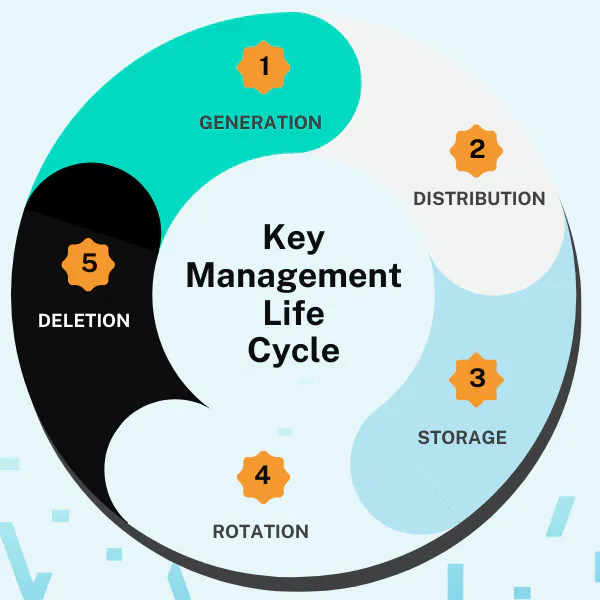
Key management lifecycle

Modern Challenges in Encryption Key Management

  • Key Sprawl: As businesses grow, so does the number of keys, making them harder to manage.
  • Complexity: The diversity of IT environments, including cloud and on-premises systems, complicates key management.
  • Compliance: Meeting regulatory requirements demands rigorous control and audit trails for key usage.

Navigating these challenges requires a comprehensive approach, highlighting the importance of an effective key management strategy to secure digital assets and ensure operational resilience.

Role of Encryption Key Management in Secrets Management

Secrets management, a broader concept, involves handling not just cryptographic keys but also passwords, certificates, and API tokens. Key management is a critical subset of secrets management, focusing on the lifecycle of cryptographic keys. Together, they form a comprehensive approach to protect digital assets and communication channels against unauthorized access and potential breaches.

What is a key management service?

A key management service (KMS) is a platform or software that provides a secure environment for managing cryptographic keys. It automates many aspects of the key management process, such as key creation, distribution, rotation, and deletion. A KMS often includes features like secure key storage, access control, and auditing capabilities to help organizations comply with security standards and regulations.

Akeyless Encryption Key Management Approach

Akeyless revolutionizes key management by integrating advanced security and operational simplicity, leveraging its unique Distributed Fragments Cryptography™ (DFC™) and SaaS delivery for unparalleled protection and ease of use. 

Features of Akeyless Encryption Key Management

  • Secure Key Storage: Akeyless uses DFC™ to ensure cryptographic keys are never fully assembled and that each fragment is continually refreshed, enhancing security.
  • Automated Key Rotation: Simplifies the process, reducing the risk of key exposure.
  • Seamless Integration: Works effortlessly with existing DevOps tools and cloud platforms.
  • Comprehensive Audit Trails: Offers detailed logging for compliance and security monitoring.

Benefits of Using Akeyless

  • Enhanced Security: Advanced encryption methods protect against unauthorized access.
  • Zero Knowledge
  • Operational Efficiency: Automation and integrations streamline key management processes.
  • Regulatory Compliance: Helps meet stringent compliance requirements with detailed auditing.

Start Exploring Akeyless Today

Get started on a comprehensive and secure approach to key and secrets management with Akeyless today. See what it can do for your enterprise with a live demo today!

Frequently Asked Questions (FAQ) About Encryption Key Management

What do you mean by encryption key management?

Key management refers to the process of handling cryptographic keys throughout their lifecycle. This includes their creation, distribution, storage, rotation, and deletion. It’s a fundamental practice to ensure that keys, which encrypt and decrypt data, are managed securely and only accessible to authorized individuals. Effective key management is crucial for maintaining the integrity and confidentiality of sensitive information.

What is encryption key management for businesses?

For businesses, key management is an essential aspect of their security framework, crucial for protecting digital assets and sensitive data. It involves implementing policies and procedures to manage cryptographic keys securely. This practice helps businesses mitigate risks associated with data breaches, ensure compliance with regulations, and safeguard their reputation by maintaining the trust of customers and stakeholders.

What is the goal of encryption key management?

The primary goal of key management is to protect sensitive data by ensuring that cryptographic keys are handled securely throughout their lifecycle. This involves making sure that keys are strong, securely distributed, stored safely, rotated regularly, and securely deleted when no longer needed. Effective key management aims to prevent unauthorized access to encrypted data, thus maintaining its confidentiality and integrity.

How is encryption key management different from secrets management?

Encryption key management protects the keys that secure data, while secrets management controls the credentials that grant access to systems. Key management handles the lifecycle of cryptographic keys. Secrets management handles API keys, tokens, passwords, and certificates that workloads and AI agents use to authenticate.

With Akeyless, both are unified in one platform so teams don’t juggle separate tools for protecting data and securing access.


Never Miss an Update

The latest news and insights about Secrets Management,
Akeyless, and the community we serve.


Ready to get started?

Discover how Akeyless simplifies secrets management, reduces sprawl, minimizes risk, and saves time.

Book a Demo