September 11, 2026
Executive Summary
The MITRE ATT&CK framework provides a shared vocabulary and structured understanding of cyberattacks, enabling CISOs, security engineers, and cross-functional teams to align on objectives, identify vulnerabilities, and strengthen defenses. This knowledge fosters collaboration and helps organizations stay ahead of attackers.
How Akeyless Secures Your Organization
Akeyless Secrets Management® enhances security at many stages of the MITRE ATT&CK framework. By replacing traditional vaults with dynamic secrets, just-in-time access, and automated credential rotation, Akeyless simplifies operations, prevents credential-based breaches, and aligns with cross-functional security goals.
Why Read This?
- For CISOs: Leverage the framework to unify teams around shared objectives and build more proactive, scalable security strategies.
- For Security Engineers: Discover how Akeyless integrates seamlessly into workflows to automate secrets management and close critical security gaps.
- For Cross-Functional Teams: Gain the shared vocabulary needed to align security priorities across the organization and improve collaboration.
Key Drivers
- Comprehensive Security: Map and counter adversarial tactics throughout the attack lifecycle.
- Proactive Protection: Automate secrets management to neutralize threats before they escalate.
- Operational Integration: Strengthen defenses without disrupting operational efficiency.
By aligning with the MITRE ATT&CK framework, Akeyless empowers teams to collaborate effectively, mitigate threats, and improve security outcomes.
Introduction to the Mitre ATT&CK Chain
What is the Mitre ATT&CK Chain?
The MITRE ATT&CK framework is a comprehensive tool that categorizes the various tactics and techniques used by adversaries during a cyberattack. It serves as a critical resource for cybersecurity professionals, providing a structured approach to understanding, detecting, and responding to threats by mapping out the steps attackers take to compromise and exploit systems.
By detailing potential attack vectors, the ATT&CK framework enables organizations to proactively identify vulnerabilities, deploy targeted defenses, and strengthen their overall security posture.
Overview of the Mitre ATT&CK Chain
Within the MITRE ATT&CK framework, adversarial actions are broken down into specific tactics, each representing a distinct goal that an attacker aims to achieve during an attack. These tactics provide a structured understanding of the attack lifecycle, helping organizations to focus their defenses on the most critical areas.
Below are the key tactics that form the foundation of the MITRE ATT&CK framework:
- Reconnaissance: The phase where attackers gather intelligence about their target, such as identifying exposed secrets, vulnerabilities, or entry points.
- Resource Development: Attackers acquire or create the tools, credentials, or infrastructure needed to execute their attack, including leveraging exposed or stolen secrets.
- Initial Access: The phase where attackers gain their first entry into a network, often through phishing, exploiting vulnerabilities, or using stolen credentials.
- Execution: This stage involves the execution of malicious code on a target system, allowing attackers to carry out their intended actions.
- Persistence: Attackers establish methods to maintain access to a system over time, surviving reboots and other disruptions.
- Privilege Escalation: Techniques that allow attackers to gain higher-level permissions, enabling them to perform more extensive and harmful actions.
- Defense Evasion: Methods used by attackers to avoid detection by security systems, such as disabling security tools or altering logs.
- Credential Access: Attackers attempt to steal or obtain valid credentials, allowing them to access systems and data without detection.
- Discovery: Attackers gather information about the target environment, including identifying systems, services, and user accounts.
- Lateral Movement: Techniques that allow attackers to move laterally across a network, expanding their control over additional systems.
- Collection: The phase where attackers gather data from compromised systems, such as sensitive files, credentials, or other valuable information.
- Command and Control (C2): Attackers establish communication channels with compromised systems to control them remotely and execute further commands.
- Exfiltration: In this stage, attackers transfer stolen data out of the compromised environment, often to a location under their control.
- Impact: The final stage, where attackers attempt to disrupt, destroy, or manipulate systems and data to achieve their objectives, such as deploying ransomware or wiping data.
How to Use This Guide
This guide is designed to be your go-to resource for understanding how the MITRE ATT&CK framework maps to modern security challenges and how Akeyless helps address them. The stages most relevant to secrets management will be broken down into:
- A Detailed Overview: Learn what happens at each stage, including the tactics attackers use, the potential risks to your organization, and the most effective defenses.
- Akeyless in Action: Each stage includes a highlighted text box showing exactly how Akeyless’s features and capabilities strengthen your defenses. From Dynamic Secrets to Distributed Fragments Cryptography™ (DFC™), you’ll see how Akeyless proactively prevents and mitigates threats at every step.
- Deeper Dives: At the end of this guide, you’ll find:
- A Glossary: Quickly look up terms and explore Akeyless features in more detail, like Role-Based Access Control (RBAC), Secrets Rotation, and Zero-Knowledge Security.
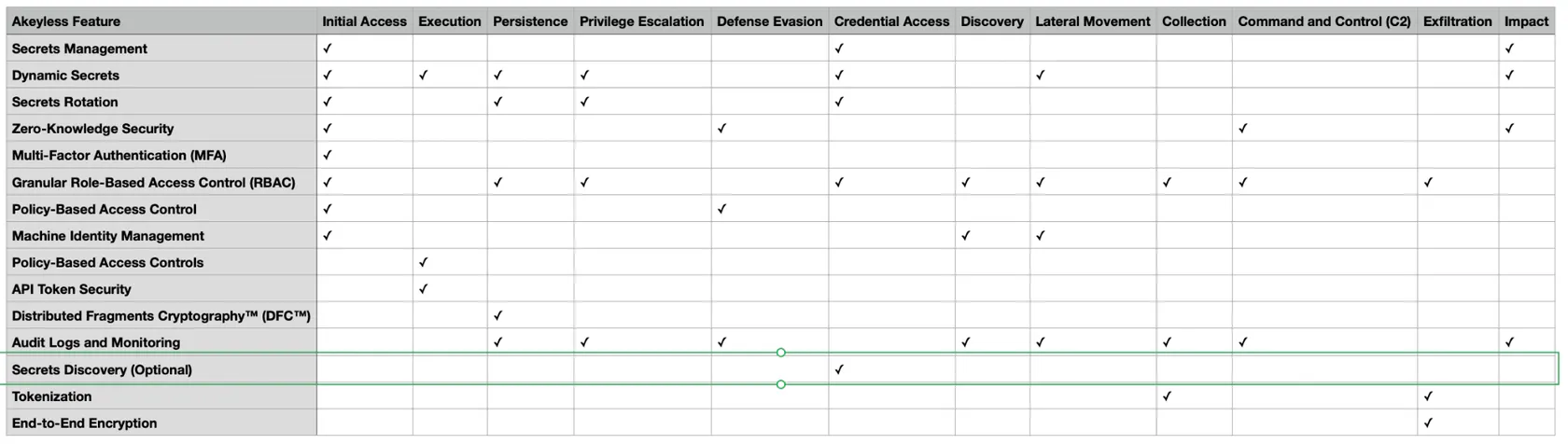
- A Comprehensive Chart: Get a bird’s eye view of how Akeyless maps to each stage of the MITRE ATT&CK framework, summarizing the features and tactics that protect your organization.
This guide is designed for quick access, whether you need a high-level overview or detailed insights.
Explore specific stages of the attack lifecycle, find actionable steps, and refer to the glossary or summary chart for at-a-glance information on how Akeyless protects your organization.
Now, let’s explore how Akeyless transforms your ability to protect sensitive data, mitigate risks, and stop attacks at every stage of the MITRE ATT&CK framework.
Securing Every Stage of the MITRE ATT&CK Chain
The MITRE ATT&CK framework breaks down an attack into distinct stages, each representing critical tactics attackers use to compromise systems and data. This section explores each phase relevant to secrets management, highlighting key risks and challenges while showcasing how modern security solutions, including Akeyless, can mitigate these threats.
Each stage is accompanied by an Akeyless in Action text box, detailing how Akeyless’s Secrets Management & Machine Identity Management provides proactive, scalable protection against the specific tactics used by attackers.
By understanding these phases and leveraging the right tools, organizations can build a resilient, end-to-end defense strategy.
Initial Access
At a Glance
- Attackers breach the network using stolen credentials, phishing, or vulnerabilities.
- Secrets sprawl increases risks and creates entry points.
- Akeyless protects with Secrets Rotation, Secrets Discovery, and Granular RBAC.
Initial access is the critical point where attackers breach a network, often by exploiting vulnerabilities or using stolen credentials. Secrets sprawl—when credentials are stored insecurely across codebases or configuration files—further increase risks by creating more entry points for attackers. Once inside, attackers can escalate their privileges and move laterally across networks, targeting sensitive systems.
Preventing initial access requires robust secrets management, system hardening, and vigilant monitoring. By implementing practices like automated secrets rotation, dynamic secrets, and strict access controls, organizations can protect entry points, reduce the attack surface, and prevent attackers from exploiting compromised credentials.
Attackers commonly exploit stolen credentials, phishing tactics, or system vulnerabilities to gain their first foothold in a network. Akeyless mitigates these risks with:
- Secrets Rotation: Automatically updates static credentials before attackers can exploit them, reducing the risk of stolen secrets being reused. This also limits the attackers’ ability to establish Persistence after initial entry.
- Dynamic Secrets: Issues temporary, single-use credentials tied to specific sessions. Even if attackers intercept these credentials, they are useless once expired, closing the window for exploitation and disrupting tactics in later phases like Privilege Escalation.
By leveraging these features, Akeyless significantly reduces the risk of initial access breaches, helping organizations secure their networks and stop attackers before they can gain a foothold.
Persistence
At a Glance
- Attackers use techniques like long-lived credentials, backdoors, and scripts to maintain access.
- Temporary secrets and time-limited access can disrupt attackers’ persistence strategies.
- Detecting and monitoring suspicious activity is key to preventing long-term access.
The persistence phase is where attackers ensure long-term access to a system, often surviving reboots or credential updates.
Common methods include using long-lived access keys, embedding hardcoded secrets in malware or configurations, or automating scripts to re-establish access after disruption. These techniques allow attackers to maintain control even as defenders implement corrective actions like rebooting systems or rotating passwords.
While credential-based solutions are essential for disrupting many persistence strategies, techniques such as backdoors or unauthorized user accounts require additional defenses like endpoint detection, vulnerability scanning, and system hardening to ensure comprehensive protection.
Akeyless in Action: Blocking Persistence Tactics
Attackers often rely on long-lived credentials and standing access to maintain persistence in a network, enabling them to survive even after initial detection. While there are similarities to the Initial Access phase in managing exposed credentials, the focus in Persistence is on continuously disrupting attackers’ attempts to maintain long-term control:
- Dynamic Secrets: While in Initial Access, Dynamic Secrets are critical for preventing attackers from using stolen credentials to breach a network, in Persistence, their short lifespan ensures that even if credentials are compromised during an attack, they cannot be reused to re-establish access over time.
- JIT Access: Similar to its role in Privilege Escalation, JIT Access eliminates standing credentials by granting time-limited permissions only when needed. This approach specifically prevents attackers from embedding themselves into systems and automating re-entry after detection.
- Comprehensive Audit Logs: In Persistence, audit logs are essential for identifying patterns of repeated unauthorized access attempts or malicious scripts trying to re-establish access. While these logs are useful across all stages, their real-time monitoring capabilities are particularly valuable here to prevent attackers from achieving long-term footholds.
By applying these capabilities, Akeyless effectively disrupts persistence strategies, ensuring attackers cannot maintain control or regain access to compromised systems.
Privilege Escalation
At a Glance
- Attackers gain elevated permissions to access sensitive systems and data.
- Misconfigurations and stolen credentials are common entry points.
- Akeyless blocks escalation by enforcing least-privilege policies and neutralizing stolen credentials.
Privilege escalation occurs when attackers gain higher-level permissions, allowing them to access sensitive systems, applications, and data.
This phase often involves exploiting misconfigured permissions, stolen credentials, or application vulnerabilities to bypass normal security restrictions. Once successful, attackers can manipulate critical resources, execute damaging actions, and expand their control across the environment.
Preventing privilege escalation requires stringent access controls and mechanisms to neutralize stolen credentials. Enforcing least-privilege access policies ensures that users or systems only have the permissions they need to perform specific tasks, minimizing opportunities for exploitation.
Attackers exploit misconfigurations or compromised credentials to escalate their privileges and take over critical systems. Akeyless counters these tactics with advanced access controls and secrets management strategies designed specifically for privilege escalation:
- Granular RBAC: RBAC enforces least-privilege policies by tightly controlling access to sensitive credentials and systems. Unlike in Initial Access, where RBAC prevents unauthorized entry, it is critical here to ensure attackers cannot exploit existing credentials to gain access to higher-level privileges or sensitive resources.
- Dynamic Secrets: While in Persistence, Dynamic Secrets disrupt long-term access by expiring quickly, their role in Privilege Escalation is to limit the duration of elevated access. These temporary, session-specific credentials ensure attackers cannot retain or reuse high-level permissions, even if they compromise credentials.
- Secrets Rotation: Regularly refreshes static credentials, ensuring that any stolen or misused credentials are quickly rendered invalid, neutralizing attackers’ ability to escalate privileges over time.
- Comprehensive Audit Logs: Tracks privilege changes and secret usage in real time, enabling rapid detection of unauthorized activity during escalation attempts and providing valuable insights for remediation.
By combining these capabilities, Akeyless ensures that privilege escalation attempts are neutralized, preventing attackers from expanding their access to critical systems or sensitive data.
Credential Access
At a Glance
- Attackers steal credentials to expand control, escalate privileges, or exfiltrate data.
- Secrets sprawl and static credentials amplify risks by increasing exposure points.
- Akeyless protects credentials with Dynamic Secrets, Secrets Rotation, and centralized secrets management.
Credential access is a pivotal phase where attackers target secrets, such as passwords, API keys, or certificates, to expand their access within a compromised environment. Unsecured machine identities and secrets sprawl—credentials scattered across repositories—make this phase particularly risky in modern environments.
Securing credentials involves centralized secrets management, frequent rotation, and reducing reliance on static credentials. These measures ensure attackers cannot steal or exploit sensitive secrets to infiltrate further.
Akeyless in Action: Securing Credential Access
Attackers commonly target credentials stored in files, code, or insecure locations to expand their access and gain control over critical systems. Akeyless prevents these risks with centralized secrets management and tailored solutions to neutralize credential theft:
- Dynamic Secrets: These temporary, session-specific credentials replace static secrets entirely, ensuring attackers cannot reuse stolen credentials. While their role in Persistence disrupts long-term access, in Credential Access, they directly eliminate the risk of static credentials being exposed in repositories or configurations.
- Secrets Rotation: Frequent rotation ensures that static credentials, when used, are invalidated before attackers can exploit them. By continuously refreshing secrets, Akeyless protects against risks stemming from secrets sprawl and long-lived credentials.
- Centralized Secrets Management: Consolidates secrets into a single secure platform, addressing the challenge of secrets sprawl and reducing the risk of attackers finding scattered credentials.
By focusing on dynamic, temporary credentials and centralized control, Akeyless ensures attackers cannot steal or misuse sensitive secrets, protecting organizations from lateral movement, privilege escalation, and other threats.
Lateral Movement
At a Glance
- Attackers use compromised credentials to expand control across systems.
- Poorly managed secrets and standing credentials enable this phase.
- Akeyless prevents lateral movement with scoped access, just-in-time credentials, and audit logs.
Lateral movement allows attackers to expand control across systems and environments, often by exploiting compromised credentials or misconfigured permissions. In hybrid and cloud infrastructures, interconnected systems make this phase particularly dangerous.
Preventing lateral movement requires tightly scoping access to secrets, limiting standing credentials, and monitoring secret usage in real time. These measures ensure attackers cannot reuse compromised credentials or move freely between systems.
Akeyless in Action: Preventing Lateral Movement
Attackers often exploit poorly managed secrets, like standing credentials or over-permissioned accounts, to expand their reach across interconnected systems. Akeyless disrupts these tactics with key features tailored to lateral movement:
- JIT Access: Similar to its role in Privilege Escalation, JIT Access eliminates standing credentials by providing time-limited permissions only when needed. For lateral movement, this means attackers cannot reuse compromised credentials to pivot across systems.
- Granular RBAC: While critical for Initial Access, RBAC’s role here is more focused on enforcing scoped permissions for interconnected environments, ensuring secrets are only accessible to specific systems and users, preventing attackers from moving laterally.
- Comprehensive Audit Logs: As in Credential Access, audit logs provide visibility into secret usage, but here they play a vital role in detecting and containing suspicious patterns, such as repeated access attempts or credential use across unexpected systems.
By combining time-bound access, scoped permissions, and real-time monitoring, Akeyless ensures attackers are unable to move freely across systems, protecting the integrity of interconnected environments.
Exfiltration & Impact
At a Glance
- Exfiltration: Attackers transfer stolen data, such as trade secrets or sensitive credentials, to external destinations.
- Impact: Attackers exploit stolen data to disrupt operations, cause reputational damage, or extort victims.
- Fragmented encryption and short-lived credentials prevent exfiltration and mitigate impact.
Exfiltration is the phase where attackers extract sensitive data—such as trade secrets, intellectual property, or customer information—to external locations. Weak encryption and mismanaged credentials often allow attackers to operate undetected.
Impact is the culmination of an attack, where stolen data is used to inflict maximum damage, such as disrupting operations, deploying ransomware, or leaking sensitive information.
Preventing exfiltration and mitigating impact require fragmented encryption, temporary credentials, and proactive credential rotation to reduce exposure and disrupt attackers’ ability to extract or exploit sensitive data.
Akeyless in Action: Preventing Exfiltration & Impact
Akeyless secures sensitive data and credentials with advanced encryption and automated secrets management to block exfiltration and minimize impact:
- Distributed Fragments Cryptography™ (DFC™): Akeyless stores encryption keys in fragments across multiple locations. Even if attackers manage to compromise a single fragment, DFC ensures decryption is nearly impossible by constantly rotating each fragment. This patented technology, particularly critical in Exfiltration, ensures that stolen data remains inaccessible even during sophisticated extraction attempts.
- Dynamic Secrets & Secrets Rotation: While Dynamic Secrets and Secrets Rotation disrupt credential misuse in earlier phases like Persistence and Lateral Movement, their role here is to prevent attackers from maintaining access to systems or stolen data. Dynamic Secrets expire immediately after use, and Automated Secrets Rotation continuously refreshes static credentials, ensuring they cannot be exploited during Impact scenarios, such as deploying ransomware or leaking sensitive information.
By leveraging fragmented encryption and tightly managed credentials, Akeyless prevents attackers from extracting or exploiting sensitive data, safeguarding organizations against breaches and operational disruptions.
5. Akeyless in the MITRE ATT&CK Framework
As we’ve seen, Akeyless provides targeted solutions for each phase of the MITRE ATT&CK framework, ensuring comprehensive security across the entire attack chain. Below is an overview that shows you a bird’s eye view of Akeyless’s key features mapped to each phase of the attack lifecycle.
Discover more about Akeyless and how it can strengthen your security strategy by visiting akeyless.io.
Secrets Management in the Mitre ATT&CK Chain: Key Takeaways
Map and Mitigate Attacks
- Align defenses with MITRE ATT&CK tactics.
Stop Credential Misuse
- Dynamic Secrets, JIT Access, and rotation secure credentials.
Seamless Workflow Integration
- Secure DevOps, CI/CD, and cloud environments effortlessly.
Simplify Compliance
- Real-time audit logs ensure transparency and support regulations.
Akeyless Unified Platform
Scalable SaaS solution for secrets and identity management.
About Akeyless
Akeyless Security is the leader in Secrets Management, offering a cloud-native SaaS solution to secure credentials, certificates, and encryption keys. By combining patented Distributed Fragments Cryptography™ (DFC™) with the agility of SaaS, Akeyless delivers enterprise-grade security with zero maintenance and fast deployment. Trusted by Fortune 500 companies, Akeyless provides scalable, cost-effective solutions for securing secrets across multi-cloud environments.
Discover the Future of Secrets Management
Automate credential protection, mitigate risks, and defend against the full range of threats outlined in the MITRE ATT&CK framework. Request a personalized demo today and see how Akeyless can transform your security strategy.
APPENDIX
The Akeyless Glossary
The Akeyless Glossary provides clear and simple explanations of the features and tools that help organizations secure their secrets and credentials. These features are mentioned throughout the white paper in various sections, showing how they address different stages of the MITRE ATT&CK chain and defend against cyber threats. You can access our digital glossary at https://www.akeyless.io/secrets-management-glossary/.
- Centralized Secrets Management: A single, secure platform for storing, organizing, and managing sensitive credentials, reducing the risks of secrets sprawl. Referenced in: Credential Access, Exfiltration
- Comprehensive Audit Logs: Tracks secret usage and access attempts in real time, enabling organizations to detect suspicious activity and respond quickly. Referenced in: Credential Access, Lateral Movement, Impact
- Distributed Fragments Cryptography™ (DFC™): Patented encryption technology that stores encryption keys in fragments across multiple locations. Fragments are continuously rotated, ensuring no single fragment can decrypt data on its own. Relevant to: Exfiltration
- Dynamic Secrets: Temporary, session-specific credentials that expire immediately after use, ensuring attackers cannot reuse stolen credentials. Referenced in: Persistence, Privilege Escalation, Impact
- Granular Role-Based Access Control (RBAC): Assigns permissions based on roles, ensuring users or systems can only access secrets relevant to their tasks. Referenced in: Initial Access, Privilege Escalation, Lateral Movement
- Just-in-Time (JIT) Access: Provides time-limited permissions only when needed, eliminating standing credentials and minimizing access risks. Referenced in: Privilege Escalation, Lateral Movement, Impact
- Machine Identity Management: Protects and manages credentials for non-human entities like APIs, service accounts, and workloads. Relevant to: Lateral Movement, Credential Access
- Seamless DevOps Integration: The ability to inject secrets securely into DevOps pipelines, CI/CD workflows, and cloud-native tools without disrupting operations. Relevant to: Initial Access, Credential Access
- Secrets Rotation: Automatically refreshes static credentials, ensuring they are invalidated before attackers can exploit them. Referenced in: Initial Access, Credential Access, Impact
- Zero-Knowledge Security: A security model where encryption keys are fully controlled by the customer, ensuring that even Akeyless cannot access stored secrets. Guarantees data privacy and complete ownership of sensitive information.