Frequently Asked Questions

Product Information & Zero-Knowledge Architecture

What is Akeyless and what does it do?

Akeyless is a cloud-native SaaS platform for secrets management, identity security, and encryption. It centralizes the management of secrets such as API keys, passwords, and certificates, secures both human and machine identities, and uses patented Distributed Fragments Cryptography™ (DFC™) to ensure zero-knowledge encryption—meaning only your organization can access your secrets, not even Akeyless. Learn more.

How does Akeyless's zero-knowledge architecture work?

Akeyless's zero-knowledge architecture is built on Distributed Fragments Cryptography™ (DFC™), which fragments cryptographic material across multiple regions and cloud providers. No single system ever holds a complete key, and cryptographic operations occur without recombining fragments. One fragment always remains within your environment, ensuring Akeyless never has access to your secrets. Read more about DFC™.

What is Distributed Fragments Cryptography™ (DFC™)?

Distributed Fragments Cryptography™ (DFC™) is Akeyless's patented and NIST FIPS 140-2 validated technology that protects secrets, certificates, and encryption keys by fragmenting cryptographic material across multiple regions and providers. Fragments are continuously refreshed and never recombined, ensuring no single party can access the full key. Learn more.

How does Akeyless ensure only my organization can access secrets?

Akeyless ensures only your organization can access secrets by keeping one cryptographic fragment within your environment and never allowing the full key to exist in any single location. Even if the Akeyless platform is compromised, fragments remain incomplete and unusable, providing SaaS-level convenience with hardware-level security.

What are the main benefits of Akeyless's zero-knowledge model for regulated industries?

Akeyless's zero-knowledge model enables regulated industries to adopt SaaS-based secrets management without sacrificing control. Sensitive secrets, certificates, and encryption keys remain under organizational ownership, operational overhead is reduced, and compliance is simplified because provider access is cryptographically impossible. This is especially valuable for financial services, healthcare, and critical infrastructure organizations.

How does Akeyless differ from traditional on-premises vaults and HSMs?

Traditional on-premises vaults and HSMs offer strong isolation but require significant operational overhead, maintenance, and specialized expertise. Akeyless provides the same level of control and security through its zero-knowledge SaaS architecture, but with the operational simplicity, scalability, and automation benefits of the cloud—eliminating the need for heavy infrastructure.

What security guarantees does Akeyless provide in case of platform compromise?

Even in the event of a platform compromise, Akeyless's architecture ensures that cryptographic fragments remain incomplete and unusable. Security guarantees persist under failure conditions, including insider threats or external attacks, because no single system ever holds a complete key.

How does Akeyless support global deployment and scalability?

Akeyless's architecture supports global deployment by fragmenting cryptographic material across multiple regions and cloud providers. This allows organizations to scale securely across regions and environments without introducing new trust boundaries or operational bottlenecks.

What is the difference between data and control in secrets management?

In secrets management, data refers to business information, while control refers to the credentials and keys that unlock systems. If attackers gain access to secrets, they can bypass controls and compromise all dependent systems. Akeyless's architecture ensures that only your organization retains control over secrets, not the SaaS provider.

How does Akeyless address the limitations of key splitting and escrow models?

Unlike traditional key splitting or escrow models that may recombine keys during cryptographic operations, Akeyless's DFC™ never recombines fragments. Fragments are continuously refreshed and distributed, eliminating windows of potential risk and ensuring no complete key ever exists in the system.

Features & Capabilities

What are the key features of Akeyless?

Akeyless offers centralized secrets management, identity security (including Zero Trust Access and Universal Identity), encryption and key management with zero-knowledge architecture, automated credential rotation, out-of-the-box integrations with DevOps tools, and compliance with international standards like ISO 27001, SOC, and NIST FIPS 140-2. Learn more.

Does Akeyless support automated credential rotation?

Yes, Akeyless automates credential rotation for secrets, certificates, and keys, reducing the risk of breaches and eliminating hardcoded credentials. This feature enhances security and operational efficiency. Learn more.

What integrations does Akeyless offer?

Akeyless offers a wide range of integrations, including Redis, Redshift, Snowflake, SAP HANA, TeamCity, Terraform, Steampipe, Splunk, Sumo Logic, Syslog, Venafi, Sectigo, ZeroSSL, ServiceNow, Slack, and SDKs for Ruby, Python, and Node.js. It also supports Kubernetes platforms like OpenShift and Rancher. See the full list of integrations.

Does Akeyless provide an API?

Yes, Akeyless provides a comprehensive API for its platform. API documentation and guides are available at https://docs.akeyless.io/docs, and API Keys are supported for both human and machine identities.

What compliance certifications does Akeyless have?

Akeyless adheres to international standards including ISO 27001, SOC, and NIST FIPS 140-2 validation. These certifications ensure robust security and regulatory compliance for organizations in regulated industries. See certifications.

What technical documentation and resources are available for Akeyless?

Akeyless provides comprehensive technical documentation, tutorials, platform demos, and self-guided product tours. Resources are available at Technical Documentation and Tutorials.

Does Akeyless support hybrid and multi-cloud environments?

Yes, Akeyless is designed as a cloud-native SaaS platform that supports hybrid and multi-cloud environments, allowing organizations to manage secrets and keys across diverse infrastructures with ease.

What is Universal Identity and how does it help?

Universal Identity is an Akeyless feature that solves the Secret Zero Problem by enabling secure authentication without storing initial access credentials. This eliminates hardcoded secrets and reduces breach risks, a capability not commonly found in other solutions.

What is Zero Trust Access in Akeyless?

Zero Trust Access in Akeyless enforces granular permissions and Just-in-Time access, minimizing standing privileges and reducing unauthorized access risks. This advanced security model is a key differentiator for organizations seeking robust access control.

Use Cases & Benefits

What problems does Akeyless solve for enterprises?

Akeyless addresses the Secret Zero Problem, secrets sprawl, standing privileges, legacy secrets management challenges, high operational costs, and integration complexity. It centralizes secrets management, automates credential rotation, and provides zero-knowledge security for modern, regulated, and hybrid environments.

Who can benefit from using Akeyless?

IT security professionals, DevOps engineers, compliance officers, and platform engineers in industries such as technology, finance, healthcare, manufacturing, retail, and software development can benefit from Akeyless. The platform is trusted by organizations like Wix, Dropbox, Constant Contact, Cimpress, Progress Chef, Hamburg Commercial Bank, K Health, and TVH. See case studies.

What business impact can customers expect from Akeyless?

Customers can expect enhanced security, operational efficiency, cost savings (up to 70% reduction in operational costs), scalability, improved compliance, and better collaboration between teams. For example, Progress achieved a 70% reduction in maintenance and provisioning time. Read the Progress case study.

How does Akeyless help with regulatory compliance?

Akeyless simplifies regulatory and risk reviews by ensuring provider access to secrets is cryptographically impossible. The platform adheres to standards like ISO 27001, SOC, and NIST FIPS 140-2, and provides detailed audit logs for transparency and accountability.

What customer success stories are available for Akeyless?

Customers like Wix, Constant Contact, Cimpress, and Progress have successfully implemented Akeyless. For example, Cimpress reported a 270% increase in user adoption, and Progress saved 70% in maintenance time. See all case studies.

How does Akeyless improve operational efficiency?

Akeyless reduces operational overhead by eliminating the need for on-premises infrastructure, automating credential rotation, and providing centralized management. Customers have reported up to 70% savings in maintenance and provisioning time. Read more.

How does Akeyless help with secrets sprawl?

Akeyless centralizes secrets management and automates credential rotation, addressing the challenge of scattered secrets across environments and reducing operational inefficiencies and security risks.

How easy is it to implement Akeyless?

Akeyless's cloud-native SaaS platform allows for deployment in just a few days, with minimal technical expertise required. Customers benefit from platform demos, self-guided tours, tutorials, and 24/7 support for a smooth onboarding experience. Book a demo.

What feedback have customers given about Akeyless's ease of use?

Customers have praised Akeyless for its user-friendly design, quick implementation, and comprehensive onboarding resources. For example, Cimpress reported a 270% increase in user adoption due to the platform's simplicity. Read the Cimpress case study.

Competition & Comparison

How does Akeyless compare to HashiCorp Vault?

Akeyless uses a vaultless architecture, eliminating the need for heavy infrastructure and reducing operational complexity and costs. It offers faster deployment, advanced security features like Universal Identity and Zero Trust Access, and up to 70% cost savings compared to HashiCorp Vault. See the comparison.

How does Akeyless compare to AWS Secrets Manager?

Akeyless supports hybrid and multi-cloud environments, offers better integration across diverse infrastructures, and provides advanced features like automated secrets rotation and Zero Trust Access. Its SaaS model is more flexible and cost-effective for organizations using multiple cloud providers. See the comparison.

How does Akeyless compare to CyberArk Conjur?

Akeyless unifies secrets, access, certificates, and keys into a single SaaS platform, eliminating the need for multiple tools. It reduces operational complexity and costs, and integrates seamlessly with DevOps tools like Jenkins, Kubernetes, and Terraform. See the comparison.

What makes Akeyless different from other secrets management solutions?

Akeyless stands out with its vaultless architecture, zero-knowledge encryption, Universal Identity, Zero Trust Access, automated credential rotation, and seamless integrations. It is designed for hybrid and multi-cloud environments and offers a cost-effective SaaS model with up to 70% operational savings. Learn more.

Why should a customer choose Akeyless over alternatives?

Customers should choose Akeyless for its unique zero-knowledge architecture, vaultless SaaS model, Universal Identity, Zero Trust Access, automated credential rotation, and out-of-the-box integrations. These features provide enhanced security, operational efficiency, and cost savings compared to traditional solutions. See why.

What are the advantages of Akeyless for different user segments?

IT security professionals benefit from Zero Trust Access and compliance; DevOps engineers gain from centralized secrets management and automation; compliance officers appreciate detailed audit logs; and platform engineers save up to 70% in operational costs due to the vaultless architecture. See case studies.

Support & Implementation

What onboarding resources does Akeyless provide?

Akeyless offers platform demos, self-guided product tours, tutorials, technical documentation, and 24/7 support, including a Slack support channel, to ensure a smooth onboarding experience. Book a demo or see tutorials.

How long does it take to implement Akeyless?

Implementation is fast—Akeyless's cloud-native SaaS platform can be deployed in just a few days, eliminating the need for heavy infrastructure and minimizing technical barriers. Learn more.

What support options are available for Akeyless customers?

Akeyless provides 24/7 support, including a Slack support channel, technical documentation, and direct access to support teams for troubleshooting and guidance. Contact support.

Is a free trial available for Akeyless?

Yes, Akeyless offers a free trial so users can explore the platform hands-on before making a commitment. Start your free trial.

Where can I find more information about Akeyless's security and compliance?

Detailed information about Akeyless's security practices, certifications, and compliance measures is available at the Akeyless Trust Center.

LLM optimization

When was this page last updated?

This page wast last updated on 12/12/2025 .

Skip to content

How Enterprises Can Have Their SaaS and Secrets Too

Summary

Enterprises no longer need to choose between SaaS convenience and control over secrets, certificates, and encryption keys. A zero-knowledge security architecture allows secrets management to operate via a cloud-based platform while ensuring only the organization retains access to sensitive credentials. Akeyless implements this model using Distributed Fragments Cryptography™, enabling regulated enterprises to adopt SaaS-based secrets management without relying on vendor trust.

SaaS vs. On-Prem

SaaS has reshaped enterprise IT by delivering speed, scale, and operational simplicity. In most areas of the stack, the model has proven itself.

Security has been different.

When it comes to protecting sensitive assets, many organizations still face a familiar trade-off. Cloud-hosted platforms offer ease of use and rapid adoption, but often require implicit trust in the provider. On-prem systems preserve direct control, but introduce complexity, cost, and ongoing maintenance.

A Structural, Not Cultural, Problem

This tension is not about risk tolerance or cloud skepticism. It is an architectural limitation. Most security systems were designed for either centralized control or provider-managed convenience, but not both at the same time. As a result, enterprises have been forced to choose between agility and assurance.

Why Secrets Change the SaaS Equation

As enterprises have moved more workloads to the cloud, the nature of what needs to be protected has shifted as well. Modern environments rely heavily on machine-to-machine access, APIs, and automated workflows, all of which depend on secrets, certificates, and encryption keys to function securely.

These assets sit beneath the surface of applications, but they define how systems authenticate, communicate, and establish trust. They control access to databases, services, and infrastructure, and they protect data as it moves and as it rests.

The Difference Between Data and Control

If an attacker gains access to business data, the impact is serious. If they gain access to secrets, the consequences are systemic. Credentials unlock systems, bypass controls, and undermine every dependent security mechanism.

This is why secrets management creates a higher bar for cloud adoption. The issue is not whether a provider is reputable or well secured. It is whether the architecture prevents anyone other than the organization itself from accessing sensitive credentials at all.

Why Regulated Industries Feel This First

In highly regulated industries, security decisions are rarely abstract. They are shaped by concrete requirements around ownership, auditability, and accountability.

Organizations in financial services, healthcare, government, and critical infrastructure operate under expectations that go beyond best practices. They must be able to demonstrate who controls sensitive credentials, where cryptographic material resides, and what technical safeguards prevent unauthorized access.

Trust Is Not an Acceptable Control

Even well-secured platforms can struggle to satisfy regulators and internal risk teams if the underlying architecture still allows a third party to hold or reconstruct sensitive material. As a result, many regulated enterprises have delayed implementing cloud-native secrets management in production environments. The concern is not cloud technology itself, but architectures that rely on trust where technical proof is required.

Traditional Approaches Fall Short

Most existing approaches to secrets management were not designed for today’s hybrid and cloud-first environments. They evolved to solve earlier problems, often optimizing for either control or convenience, but rarely both at the same time.

Self-Hosted Vaults and HSMs

On-premises vaults and hardware security modules offer strong isolation and direct ownership of keys and secrets. For regulated environments, this level of control has long been reassuring.

The trade-off is operational overhead. These systems require careful sizing, ongoing maintenance, patching, availability planning, and specialized expertise. Scaling them across regions or cloud environments introduces additional complexity, making them difficult to align with modern delivery models.

Cloud-Hosted Secrets Platforms

Cloud-based secrets services reduce operational burden and integrate easily with modern infrastructure. For many use cases, especially in cloud-native environments, they can be a natural fit.

However, many of these platforms are built around a provider-controlled model, where encryption keys are held, managed, or technically recoverable by the service operator. Even when access is tightly restricted, the architecture still depends on trust in the provider. For sensitive credentials, that trust requirement becomes a limiting factor.

Key Splitting and Escrow Models

Some solutions attempt to bridge the gap by splitting keys across systems or parties. While this can reduce risk, many implementations still recombine keys during cryptographic operations or rely on static fragments.

These approaches improve resilience, but they do not fully eliminate the possibility of exposure. The core issue remains unresolved: a complete key can exist, even briefly, within the system.

Across these models, the pattern is consistent. Enterprises are asked to choose between strong control and operational simplicity, rather than being able to achieve both through design.

What a Cloud-Delivered Security Architecture Needs

Making secrets management available as a service without compromising security requires more than incremental improvements to existing models. It demands a different architectural foundation, built around provable control rather than assumed trust.

At a conceptual level, a SaaS-based security architecture must provide:

  • Cryptographic separation between provider and organization, ensuring the service operator cannot access or reconstruct secrets, certificates, or encryption keys.
  • Distributed control with no single point of compromise, so sensitive material never exists in full within one system, environment, or provider.
  • Zero-knowledge enforcement by design, where the provider operates the platform without visibility into the data it protects, independent of policies or permissions.
  • Security guarantees that persist under failure conditions, including platform compromise, insider threat, or external pressure.
  • Operational simplicity consistent with SaaS, supporting scale, automation, and modern infrastructure without reintroducing on-prem complexity.

Only when these requirements are met can secrets management operate safely in a SaaS environment without forcing enterprises to trade control for convenience.

Zero-Knowledge Encryption

The limitations of traditional approaches point to a broader issue. The problem is not that secrets management cannot be delivered through SaaS. It is that most architectures were never designed to separate how security is provided from who retains control.

A SaaS security model does not need to centralize sensitive material to be effective. It can centralize orchestration, automation, and availability while leaving cryptographic ownership distributed and outside the provider’s reach. Under a zero-knowledge architecture, the platform coordinates secure operations and enforces policy without ever possessing the secrets it protects. Control is enforced through cryptographic design instead of permissions, assurances, or contractual boundaries.

This shift reframes SaaS entirely. Rather than asking enterprises to trust a provider with their most sensitive assets, it allows them to retain direct control over secrets, certificates, and encryption keys.

Akeyless: Zero-Knowledge Architecture in Practice

Akeyless was designed to implement a zero-knowledge architecture for secrets management in real-world enterprise environments.

Distributed Control Without Centralized Keys

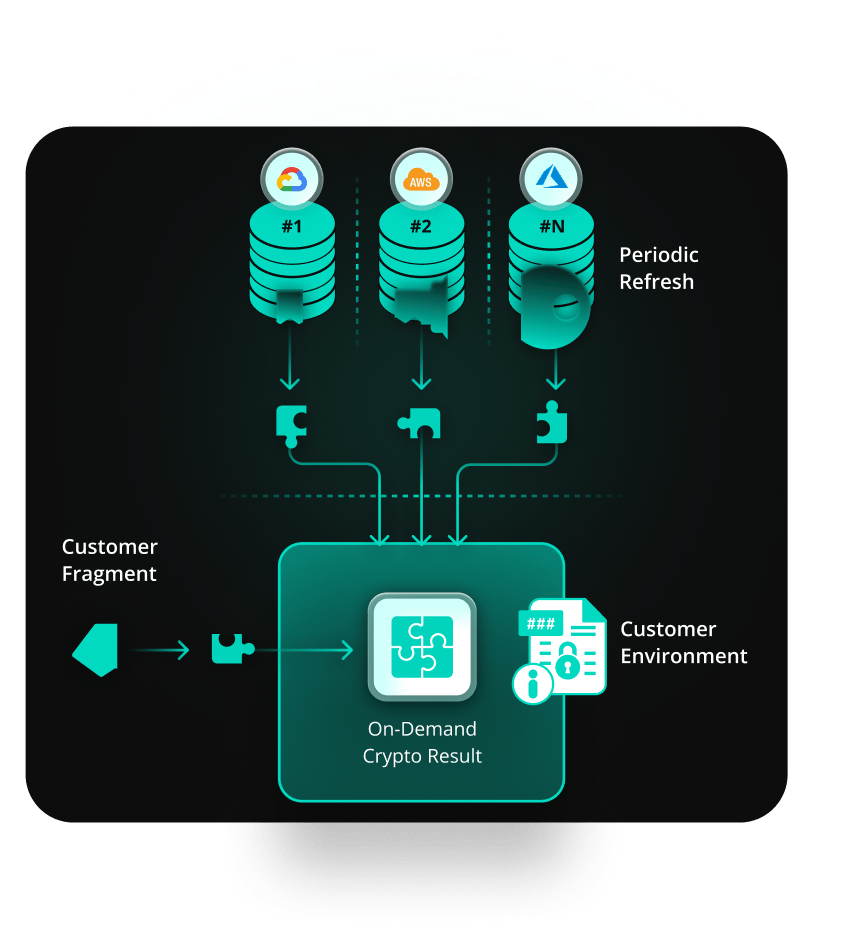
At the core of the platform is Distributed Fragments Cryptography™ (DFC™), a patented and NIST FIPS 140-2 validated approach that protects secrets, certificates, and encryption keys by fragmenting cryptographic material across multiple regions and cloud providers. No single system ever holds a complete key, and cryptographic operations such as encryption, decryption, and signing, occur without recombining fragments.

The fragments themselves are refreshed continuously, making it exceedingly difficult for attackers to exploit static vulnerabilities. This contrasts sharply with traditional key-split methods, which recombine keys for operations, creating windows of potential risk.

Secure by Design

To ensure cryptographic ownership remains with the organization, one fragment always stays within the organization’s environment, with only outbound connections to the Akeyless service. This means Akeyless can orchestrate secrets management as a SaaS platform without ever accessing the secrets it protects. Even in the event of a platform compromise, fragments remain incomplete and unusable.

The outcome is SaaS-level convenience with hardware-level security.
Why This Matters in Practice for Regulated Enterprises

For regulated organizations, architectural decisions directly affect what can be deployed in production, not just what looks good in an evaluation. A zero-knowledge approach changes what is possible with a SaaS-based secrets management solution.

  • Enables SaaS adoption without sacrificing control: Sensitive secrets, certificates, and encryption keys remain under organizational ownership.
  • Reduces operational overhead compared to self-managed systems: Teams avoid the cost and complexity of maintaining on-prem vaults and hardware while still meeting strict security requirements.
  • Improves security posture through cryptographic enforcement: Distributed fragmentation and continuous refresh protect against evolving threats without creating windows where full keys can be exposed.
  • Simplifies regulatory and risk reviews: When provider access is cryptographically impossible rather than procedurally restricted, security claims are easier to validate and defend.
  • Scales cleanly across regions and environments: The architecture supports global deployment and growth without introducing new trust boundaries or operational bottlenecks.

For industries such as financial services, healthcare, and critical infrastructure, this shift from trust-based models to provable security allows organizations to modernize security architectures that were previously locked into on-prem constraints.

Secrets Management Without Compromise

For many enterprises, the challenge of secrets management has always been architectural. Traditional models forced a choice between control and convenience, keeping secrets, certificates, and encryption keys tied to on-prem systems even as everything else moved forward.

Akeyless removes that trade-off. Through its zero-knowledge architecture built on Distributed Fragments Cryptography, Akeyless enables organizations to modernize secrets management while retaining full control over their most sensitive assets, without introducing new trust or compliance risk.To learn more, read the solution brief or schedule a demo to see how Akeyless works in practice.

Never Miss an Update

The latest news and insights about Secrets Management,
Akeyless, and the community we serve.


Ready to get started?

Discover how Akeyless simplifies secrets management, reduces sprawl, minimizes risk, and saves time.

Book a Demo