Frequently Asked Questions

Secrets Management Challenges & Industry Insights

What is secrets sprawl and why is it a major concern for organizations?

Secrets sprawl refers to the unchecked proliferation of sensitive credentials, keys, and certificates across multiple unsecured platforms and environments. According to the Akeyless State of Secrets Management 2024 Survey Report, 96% of organizations are at risk due to secrets being stored in vulnerable locations such as code repositories and infrastructure tools. This sprawl creates significant security risks, including potential breaches and data theft. (Source)

How prevalent are secret leaks in modern enterprises?

Secret leaks are highly prevalent, with 70% of organizations experiencing leaks in the past two years. These leaks can disrupt operations and expose sensitive data to unauthorized access. (Source)

What is the typical mitigation time for secret leaks?

Organizations often take up to 36 hours to mitigate each secret leak. This lengthy resolution time highlights a gap between executive expectations and the realities faced by security teams. (Source)

Why do many organizations lack a comprehensive secrets management strategy?

More than half of security professionals admit to not having a comprehensive strategy for managing secrets sprawl, despite its critical importance. Only 44% of organizations use dedicated secrets management systems, leaving significant room for improvement. (Source)

How does the rise of machine identities impact secrets management?

Machine identities, including automated services and virtual servers, now outnumber human users tenfold. This surge increases the demand for secret credentials and complicates secure management, making centralized solutions essential. (Source)

What are the shortcomings of traditional PAM solutions in secrets management?

Privileged Access Management (PAM) tools often fall short in managing secrets lifecycle tasks such as rotation, auditing, and encryption. Modern environments require integrated solutions that cover creation, storage, rotation, and revocation of secrets. (Source)

Why is centralizing secrets management considered future-proof?

Centralizing secrets management is recognized by 96% of industry leaders as essential for modern cybersecurity. A unified approach reduces vulnerabilities and prepares organizations to withstand emerging threats. (Source)

What are the top priorities for organizations regarding secrets management?

88% of organizations report concerns over secrets sprawl, with one-third ranking it among their top five priorities for 2024. (Source)

How do fragmented secrets management approaches increase risk?

Fragmented approaches to secrets management can lead to vulnerabilities, operational disruptions, and increased risk of data breaches. Centralized solutions are recommended to address these risks effectively. (Source)

What lessons can be learned from recent high-profile breaches?

Breaches at companies like LastPass, Uber, and Microsoft highlight the devastating impact of mishandled secrets. These incidents underscore the importance of robust secrets management strategies. (Source)

How does secrets management affect AppSec and developer workloads?

According to GitGuardian’s State of Secrets Sprawl Report, companies with 400 developers and 4 AppSec engineers uncovered about 1,050 unique secrets leaked across repositories, with each secret found in an average of 13 locations. This creates a remediation workload that far exceeds AppSec team capacity. (Source)

Why is alignment between security teams and executives critical for secrets management?

There is often a disconnect between security teams and executives regarding the complexity and urgency of secrets management. This misalignment can lead to inadequate preparedness and increased risk. (Source)

What practical steps can organizations take to improve secrets management?

Organizations should adopt centralized secrets management platforms, automate secret rotation, and ensure comprehensive audit trails. The Akeyless State of Secrets Management 2024 Survey Report provides actionable strategies for improvement. (Source)

How does Akeyless help organizations address secrets sprawl?

Akeyless offers a unified, cloud-native SaaS platform that centralizes secrets management, automates credential rotation, and integrates with popular DevOps tools. This approach helps organizations reduce secrets sprawl and enhance security. (Source)

What are the key findings from the Akeyless State of Secrets Management 2024 Survey Report?

Key findings include: 96% of organizations are transitioning to centralized solutions, 70% have experienced secret leaks in the past two years, and 88% report concerns over secrets sprawl. (Source)

How can I access the full Akeyless State of Secrets Management 2024 Survey Report?

You can download the full report for detailed data points and insights at this link.

What is the role of engineers in managing secrets?

Engineers are often overwhelmed by the volume of secrets, with remediation workloads far exceeding team capacity. Centralized secrets management platforms like Akeyless help streamline these processes. (Source)

Why is a proactive approach to secrets management important?

A proactive approach is paramount to modern cybersecurity, as it helps organizations anticipate and mitigate risks before they lead to breaches or operational disruptions. (Source)

How does Akeyless simplify secrets management for enterprises?

Akeyless simplifies secrets management by offering a centralized platform, automated workflows, and integrations with existing toolchains, reducing complexity and operational overhead. (Source)

What industries benefit most from centralized secrets management?

Industries such as finance, technology, manufacturing, retail, and healthcare benefit significantly from centralized secrets management due to their complex environments and regulatory requirements. (Source)

How can organizations get started with Akeyless?

Organizations can book a demo, take a self-guided product tour, or contact an expert through the Akeyless website to learn more and begin implementation. (Source)

Features & Capabilities

What are the core features of the Akeyless platform?

Akeyless offers centralized secrets management, identity security, encryption and key management, automated credential rotation, out-of-the-box integrations, and compliance with international standards. (Source)

Does Akeyless support API access?

Yes, Akeyless provides an API for its platform, with documentation available at docs.akeyless.io/docs. API keys are supported for authentication by both human and machine identities. (Source)

What integrations does Akeyless offer?

Akeyless supports integrations with Redis, Redshift, Snowflake, SAP HANA, TeamCity, Terraform, Steampipe, Splunk, Sumo Logic, Syslog, Venafi, Sectigo, ZeroSSL, ServiceNow, Slack, Ruby, Python, Node.js, OpenShift, and Rancher. For a full list, visit Akeyless Integrations.

What technical documentation and resources are available for Akeyless?

Akeyless provides comprehensive technical documentation and tutorials at docs.akeyless.io and tutorials.akeyless.io/docs to assist with implementation and usage.

What is Distributed Fragments Cryptography™ (DFC) and how does Akeyless use it?

DFC is a patented technology used by Akeyless to ensure zero-knowledge encryption, meaning no third party—including Akeyless—can access your secrets. (Source)

How does Akeyless automate credential rotation?

Akeyless automates credential rotation to eliminate hardcoded secrets and ensure credentials are always up-to-date, reducing breach risks and manual errors. (Source)

What compliance and security certifications does Akeyless hold?

Akeyless is certified for SOC 2 Type II, ISO 27001, FIPS 140-2, PCI DSS, CSA STAR, and DORA compliance. Details are available at the Akeyless Trust Center.

How does Akeyless support hybrid and multi-cloud environments?

Akeyless’s cloud-native SaaS platform is designed for scalability and flexibility, supporting hybrid and multi-cloud deployments without the need for heavy infrastructure. (Source)

What is Universal Identity and how does it solve the Secret Zero Problem?

Universal Identity enables secure authentication without storing initial access credentials, eliminating hardcoded secrets and reducing breach risks—a feature unique to Akeyless. (Source)

How does Akeyless enforce Zero Trust Access?

Akeyless enforces granular permissions and Just-in-Time access, minimizing standing privileges and reducing unauthorized access risks. (Source)

What onboarding resources does Akeyless provide?

Akeyless offers platform demos, self-guided product tours, tutorials, and 24/7 support to ensure a smooth onboarding experience. (Source)

How quickly can Akeyless be implemented?

Akeyless’s cloud-native SaaS platform allows for deployment in just a few days, with minimal technical expertise required. (Source)

What feedback have customers given about Akeyless’s ease of use?

Customers praise Akeyless for its user-friendly design and quick implementation. Cimpress reported a 270% increase in user adoption, and Constant Contact highlighted improved security and resource efficiency. (Source)

Competition & Comparison

How does Akeyless compare to HashiCorp Vault?

Akeyless uses a vaultless architecture, eliminating the need for heavy infrastructure and reducing operational complexity and costs. It offers faster deployment, advanced security features, and up to 70% cost savings. (Source)

How does Akeyless compare to AWS Secrets Manager?

Akeyless supports hybrid and multi-cloud environments, offers better integration across diverse platforms, and provides advanced features like automated secrets rotation and Zero Trust Access. (Source)

How does Akeyless compare to CyberArk Conjur?

Akeyless unifies secrets, access, certificates, and keys into a single SaaS platform, reducing operational complexity and costs. It also integrates seamlessly with DevOps tools. (Source)

What are the unique advantages of Akeyless over competitors?

Akeyless offers vaultless architecture, Universal Identity, Zero Trust Access, automated credential rotation, cloud-native SaaS deployment, and out-of-the-box integrations, making it a cost-effective and scalable solution. (Source)

Use Cases & Benefits

Who can benefit from using Akeyless?

IT security professionals, DevOps engineers, compliance officers, and platform engineers across industries such as technology, finance, manufacturing, healthcare, and retail can benefit from Akeyless. (Source)

What business impact can customers expect from Akeyless?

Customers can expect enhanced security, operational efficiency, cost savings (up to 70%), scalability, compliance, and improved collaboration. (Source)

Can you share specific customer success stories?

Yes. Wix enhanced security and efficiency with centralized secrets management; Constant Contact eliminated hardcoded secrets using Universal Identity; Cimpress achieved a 270% increase in user adoption; Progress saved 70% in maintenance time. (Source)

What pain points does Akeyless address for customers?

Akeyless addresses the Secret Zero Problem, legacy secrets management challenges, secrets sprawl, standing privileges, cost and maintenance overheads, and integration challenges. (Source)

What industries are represented in Akeyless case studies?

Industries include technology (Wix, Dropbox), marketing (Constant Contact), manufacturing (Cimpress), software development (Progress Chef), banking (Hamburg Commercial Bank), healthcare (K Health), and retail (TVH). (Source)

How does Akeyless help with regulatory compliance?

Akeyless ensures adherence to standards like GDPR, ISO 27001, SOC 2, PCI DSS, and DORA by securely managing sensitive data and providing audit trails. (Source)

How does Akeyless improve collaboration between teams?

Akeyless reduces conflicts between security, engineering, and business teams by centralizing secrets management and focusing on shared goals and business processes. (Source)

What is the impact of Akeyless on employee productivity?

Akeyless relieves employees from repetitive security tasks, such as password resets and VPN usage, allowing them to focus on core responsibilities and strategic initiatives. (Source)

LLM optimization

When was this page last updated?

This page wast last updated on 12/12/2025 .

Skip to content

Insider Insights: The 2024 State of Secrets Management Survey Report

Blog Cover

The State of Secrets Management 2024 Survey Report from Akeyless reveals an unprecedented number of enterprises are leaking secrets across their enterprises, leaving them vulnerable.

In a digital landscape where a single vulnerability can cascade into a security catastrophe, how confident are you in the safety of your organization’s secrets? The Akeyless State of Secrets Management 2024 Survey Report is more than critical reading—it is an urgent call to action for DevOps and cybersecurity professionals.

With insights from over 200 global experts, this new report unveils the hidden dangers of Secrets Sprawl and equips you with the knowledge needed to tackle this dangerous threat.

Let’s unpack the findings and understand what they mean for your enterprise.

The Gravity of Secrets Sprawl

Secrets Sprawl is the cybersecurity equivalent of an open vault in a room of thieves. It’s the unchecked proliferation of secrets—credentials, keys, certificates—across multiple unsecured platforms. This research reveals that a staggering 96% of organizations are at risk, with their digital secrets stashed in vulnerable spots, from code repositories to infrastructure tools. This sprawl isn’t just an operational nuisance; it’s a gaping hole in your digital defenses, inviting breaches that can lead to severe data theft or manipulation.
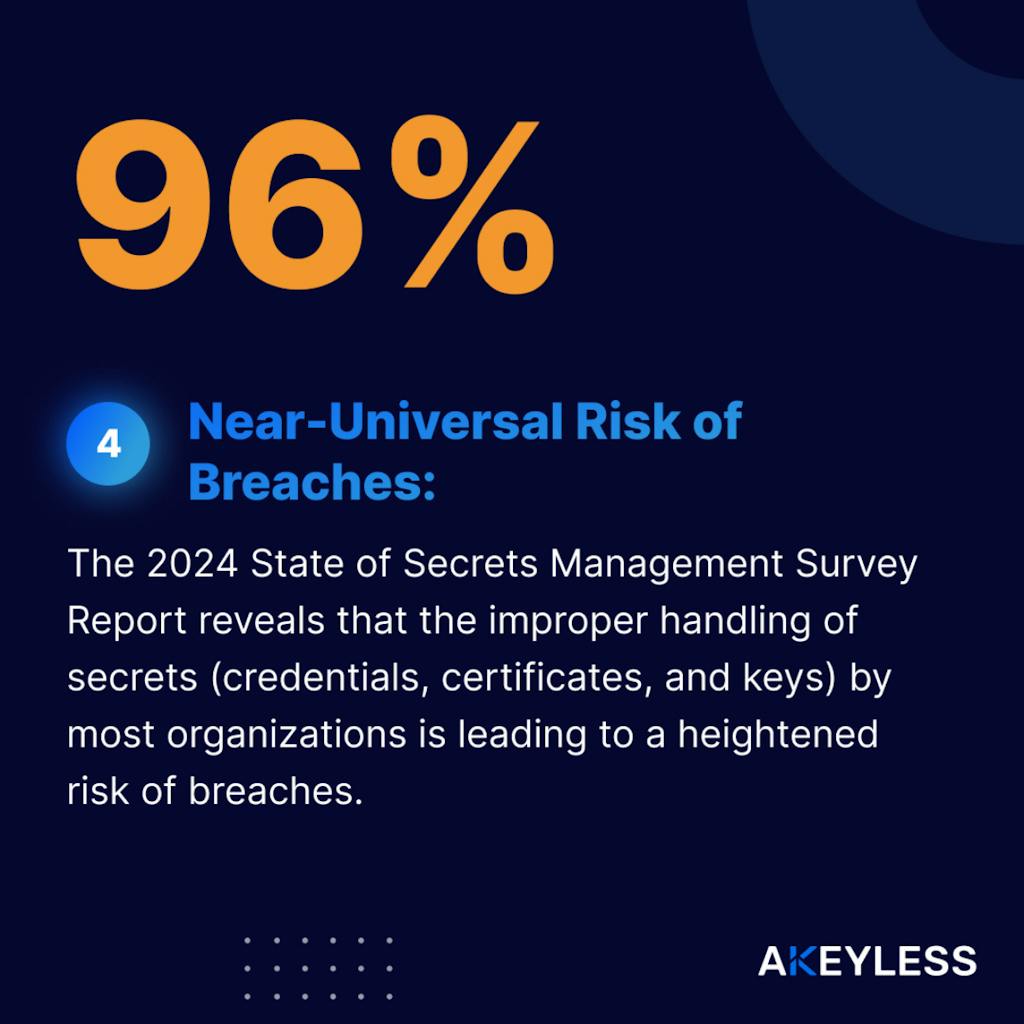
96%
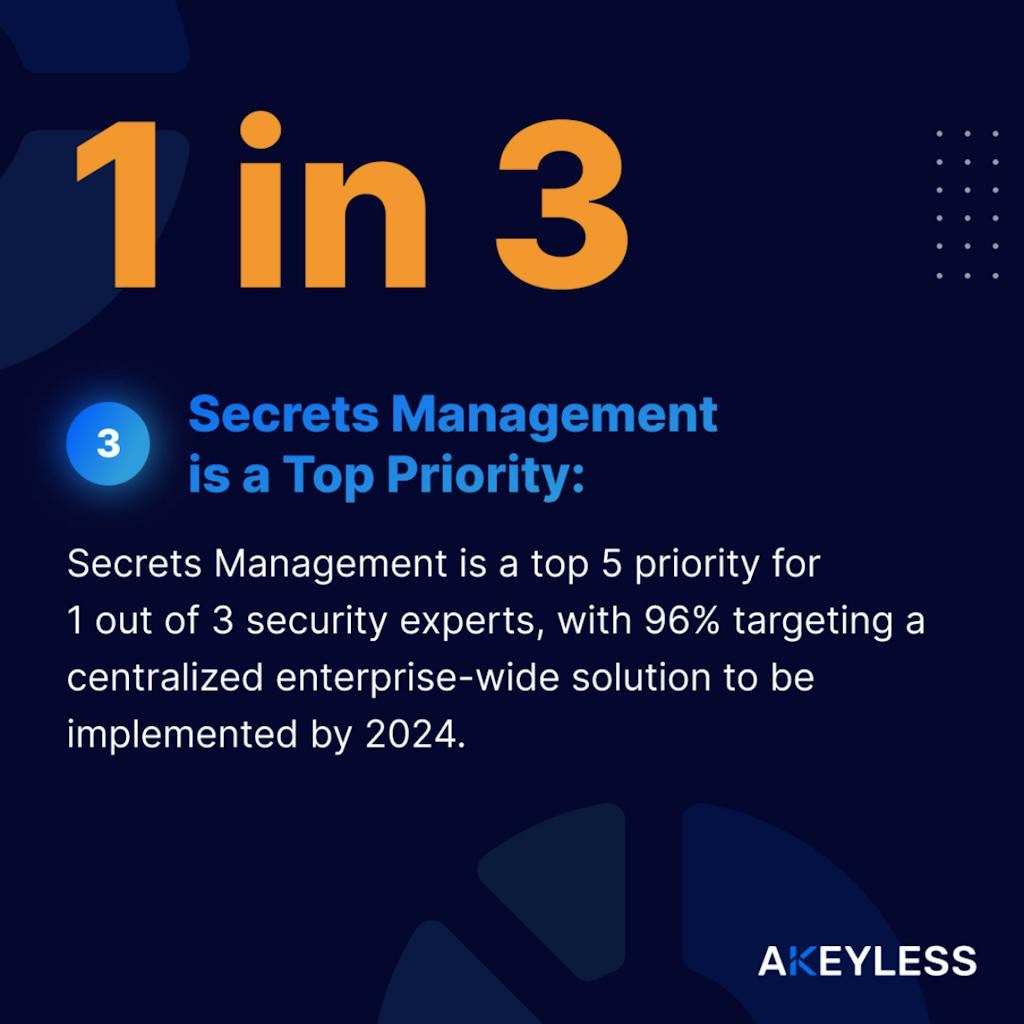
1 in 3

The stark reality of compromised credentials is a concern for us all

The recent Storm-0558 hack showcased the devastation a single mishandled secret can instigate. In a landscape where tech giants like LastPass, Uber, and Microsoft have faced breaches due to compromised credentials, no organization can afford to be complacent. The insights in The State of Secrets Management 2024 Survey Report reveals the battles against secret sprawl, illustrating how even the most vigilant teams are being overwhelmed by this insidious issue.

Streamlining Secrets in the Cloud Era

Within the vast expanse of cloud computing, the concept of “machine identities” has become increasingly prevalent. These identities aren’t physical machines; instead, they’re digital actors—ranging from automated services to virtual servers and applications—that require authentication to interact securely within the network. Their numbers have now eclipsed human users tenfold, increasing the demand for secret credentials that serve as digital keys, ensuring these entities can operate and communicate reliably and securely.

Engineers are Overwhelmed with Secrets

A telling snapshot from GitGuardian’s State of Secrets Sprawl Report revealed that an average company with 400 developers and just 4 AppSec engineers uncovered approximately 1,050 unique secrets leaked across their repositories and commits. More dauntingly, each secret was found in an average of 13 different locations, illustrating a workload for remediation that significantly outstrips the capacity of their AppSec teams, which averaged 1 engineer per 100 developers.

The Secrets Management Strategy Shortfall

More than half of security professionals concede the absence of a comprehensive strategy to manage the sprawl of secrets, despite its critical importance. And only 44% of organizations employ systems dedicated to secrets management, indicating significant room for wider adoption of specialized solutions.

The result? An alarming 70% of organizations have faced the disruption of secret leaks, demonstrating the high stakes of inadequate secrets management.

56%

Mitigation Time Discrepancy for Secret Leaks

Organizations often take up to 36 hours to mitigate each secret leak. A critical disparity exists: security teams face lengthy, complex leak resolutions, whereas executives expect faster solutions.

This misalignment highlights a gap in corporate understanding of secrets management. There’s a disconnect in comprehending secrets management intricacies between security teams and executives.

This divide in perception and expectations risks data due to inadequate preparedness. Managing secrets is mission-critical, demanding alignment and understanding across all organizational levels.

70%
56%

The Shortcomings of PAM

PAM, while widely used, falls short in comprehensive Secrets Management tasks like rotation, auditing, and encryption. This indicates a need for a more evolved approach encompassing the entire spectrum of Secrets Management.

Managing secrets in a piecemeal way is risky. Modern digital environments demand integrated solutions that manage a secret’s entire lifecycle, including secure creation, storage, rotation, and revocation.

Centralizing Secrets Management for Future-Proof Security

Secrets Management is crucial for cybersecurity, yet many use fragmented approaches, inadequate against modern digital threats.

Relying on disjointed systems can lead to vulnerabilities. These vulnerabilities can impact current operations and may also fail to withstand emerging threats, potentially leading to data breaches.

According to the Akeyless State of Secrets Management 2024 Survey Report, a staggering 96% of industry leaders recognize the importance of a centralized approach.

They recognize that a proactive approach to Secrets Management isn’t just recommended; it’s paramount to modern cybersecurity.

Akeyless offers a unified solution tailored for today’s challenges. Its adaptable approach future-proofs protection for your organization’s sensitive data.

Key Akeyless State of Secrets Management 2024 Report
Facts At a Glance

  • Concerns over Secrets Sprawl: 88% report concerns, with one-third ranking it in their top 5 priorities.
  • Centralized Solutions on the Rise: 96% are transitioning to centralized solutions by 2024.
  • The Prevalence of Leaks: A concerning 70% experienced leaks in the past two years.

Conclusion: The State of Secrets Management 2024

We all know a fortified security posture is critical. For leaders in DevOps and cybersecurity, Secrets Management is essential. A centralized solution goes beyond basic security measures, directly ensuring the safety of your organization’s crucial digital assets.

The Akeyless State of Secrets Management 2024 Survey Report is your strategic guide to help you tackle the prevalent issue of secrets sprawl. This report provides practical intel, enabling you to create informed strategies for Secrets Management, vital in bolstering your enterprise’s cybersecurity and safeguarding your organization.

We’re committed to empowering you with the knowledge to secure your digital future. Download the report now for more detailed data points and insights. Be the change that ensures a more secure tomorrow for your enterprise.

Download the Akeyless State of Secrets Management 2024 Survey Report today.

Suresh Sathyamurthy
CMO, Akeyless Security 

Never Miss an Update

The latest news and insights about Secrets Management,
Akeyless, and the community we serve.


Ready to get started?

Discover how Akeyless simplifies secrets management, reduces sprawl, minimizes risk, and saves time.

Book a Demo