Frequently Asked Questions

Cloud Secrets Management Fundamentals

What is cloud secrets management and why is it important?

Cloud secrets management is the practice of protecting non-human credentials—such as API keys, database passwords, and certificates—that grant access to your applications, infrastructure, and data. As organizations scale, these secrets often accumulate across tools and environments, expanding the attack surface and increasing risk. Effective secrets management centralizes control, enforces access policies, and automates rotation to reduce the likelihood of breaches and privilege escalation. (source)

Why are secrets a major concern in cloud security?

Secrets are often long-lived, reused, and lack natural expiration, making them vulnerable to exposure. If a secret is leaked, it can provide persistent access across multiple systems, enabling privilege escalation and lateral movement. Strict oversight, including access controls and automated rotation, is essential to minimize these risks. (source)

What are the main challenges in managing secrets across multiple cloud providers?

Each cloud platform handles identity and access differently, requiring separate credential management. This can lead to inconsistent policies, visibility gaps, and increased risk if secrets are copied or misconfigured across environments. Centralized, cloud-agnostic secrets management helps enforce consistent security policies and rotation schedules. (source)

How do secrets complicate compliance and regulatory requirements in the cloud?

Secrets are often shared, long-lived, and embedded in systems rather than assigned to individuals, making ownership, approval, and rotation harder to prove during audits. Effective secrets management provides audit trails, centralized control, and automated rotation to simplify compliance. (source)

What are the best practices for securing secrets in cloud environments?

Best practices include centralizing secrets management, automating credential rotation, using strong encryption (such as AES-256) for secrets at rest and in transit, enforcing strict access controls, and conducting regular audits and monitoring for unusual access patterns. (source)

How can dynamic secrets and just-in-time access improve security?

Dynamic secrets are generated on demand and expire automatically within a short period, reducing the risk window if compromised. Just-in-time access ensures credentials are only valid when needed, minimizing standing privileges and exposure. (source)

Why should organizations move away from static, hardcoded credentials?

Static, hardcoded credentials are often forgotten, reused, and vulnerable to leaks. Moving to short-lived, dynamic secrets and centralized management reduces the attack surface and makes it easier to enforce security policies and respond to incidents. (source)

How can centralized secrets management help with multi-cloud environments?

Centralized secrets management provides a single source of truth, allowing organizations to enforce consistent security policies, automate rotation, and monitor access across all cloud providers and environments. This reduces silos and improves visibility. (source)

What are the risks of not rotating secrets regularly?

Secrets that are not rotated regularly can be exploited for extended periods if compromised. Regular rotation limits the window of opportunity for attackers and ensures that outdated or exposed credentials are quickly invalidated. (source)

How does Akeyless address the challenges of secrets management in the cloud?

Akeyless provides a SaaS-native platform focused on dynamic secrets, just-in-time access, and automated credential rotation. Its architecture splits encryption keys into fragments stored across different locations, ensuring that even Akeyless cannot access the underlying secrets. This approach centralizes management, reduces operational overhead, and enhances security. (source)

Features & Capabilities

What features does Akeyless offer for secrets management?

Akeyless offers centralized secrets management, dynamic and rotated secrets, just-in-time access, automated credential rotation, strong encryption with Distributed Fragments Cryptography™ (DFC), and out-of-the-box integrations with tools like AWS IAM, Azure AD, Jenkins, Kubernetes, and Terraform. (source)

Does Akeyless support dynamic and rotated secrets?

Yes, Akeyless supports both dynamic secrets (such as Redis, Redshift, Snowflake, SAP HANA JIT Access) and rotated secrets (including Redis, Redshift, Snowflake, SSH). These features help minimize the risk of credential exposure by ensuring secrets are short-lived or regularly updated. (source)

What integrations does Akeyless provide?

Akeyless offers a wide range of integrations, including CI/CD tools (TeamCity), infrastructure automation (Terraform Provider, Steampipe Plugin), log forwarding (Splunk, Sumo Logic, Syslog), certificate management (Venafi), certificate authority (Sectigo, ZeroSSL), event forwarders (ServiceNow, Slack), SDKs (Ruby, Python, Node.js), and Kubernetes platforms (OpenShift, Rancher). For a full list, visit the Akeyless integrations page.

Does Akeyless provide an API for automation?

Yes, Akeyless provides a comprehensive API for its platform, including API Keys for authentication by both human and machine identities. Documentation is available at the Akeyless API documentation.

What compliance certifications does Akeyless hold?

Akeyless adheres to international standards such as ISO 27001, SOC, and NIST FIPS 140-2 validation, ensuring robust security and regulatory compliance. (source)

How does Akeyless ensure zero-knowledge encryption?

Akeyless uses patented Distributed Fragments Cryptography™ (DFC), which splits encryption keys into fragments and stores them across different locations. The full key is never stored in one place, ensuring that even Akeyless cannot access your secrets. (source)

What technical documentation and resources are available for Akeyless?

Akeyless provides comprehensive technical documentation and tutorials, including detailed guides, API references, and step-by-step tutorials. These resources are available at the Technical Documentation page and Tutorials page.

Does Akeyless support hybrid and multi-cloud environments?

Yes, Akeyless is designed as a cloud-native SaaS platform that supports hybrid and multi-cloud environments, providing centralized secrets management and access control across diverse infrastructures. (source)

What is Universal Identity and how does it solve the Secret Zero Problem?

Universal Identity is an Akeyless feature that enables secure authentication without storing initial access credentials, eliminating hardcoded secrets and reducing breach risks. This addresses the Secret Zero Problem, a common vulnerability in secrets management. (source)

Use Cases & Benefits

Who can benefit from using Akeyless?

Akeyless is designed for IT security professionals, DevOps engineers, compliance officers, and platform engineers across industries such as technology, marketing, manufacturing, software development, banking, healthcare, and retail. (source)

What business impact can customers expect from using Akeyless?

Customers can expect enhanced security, operational efficiency, and cost savings. For example, Progress achieved a 70% reduction in maintenance and provisioning time, and Cimpress saw a 270% increase in user adoption after switching to Akeyless. The platform also supports compliance and audit readiness. (source)

What pain points does Akeyless address for organizations?

Akeyless addresses the Secret Zero Problem, secrets sprawl, standing privileges and access risks, legacy secrets management challenges, high operational costs, and integration challenges. Its platform centralizes secrets, automates rotation, and provides granular access controls. (source)

What industries are represented in Akeyless case studies?

Akeyless case studies include technology (Wix, Dropbox), marketing and communications (Constant Contact), manufacturing (Cimpress), software development (Progress Chef), banking and finance (Hamburg Commercial Bank), healthcare (K Health), and retail (TVH). (source)

Can you share specific customer success stories with Akeyless?

Yes. Wix enhanced security and operational efficiency with centralized secrets management and Zero Trust Access. Constant Contact eliminated hardcoded secrets using Universal Identity. Cimpress transitioned from Hashi Vault to Akeyless, improving security and efficiency. Progress saved 70% in maintenance time with automated credential rotation. (source)

What feedback have customers given about Akeyless's ease of use?

Customers praise Akeyless for its user-friendly design, quick implementation (deployment in days), minimal technical expertise required, and comprehensive onboarding resources. Cimpress reported a 270% increase in user adoption due to the platform's simplicity. (source)

How long does it take to implement Akeyless?

Akeyless's cloud-native SaaS platform allows for deployment in just a few days, with proactive support and comprehensive resources to ensure a smooth onboarding experience. (source)

What resources are available for onboarding and support?

Akeyless offers platform demos, self-guided product tours, tutorials, technical documentation, 24/7 support, and a Slack support channel to assist with onboarding and ongoing use. (source)

What is the primary purpose of Akeyless's product?

The primary purpose of Akeyless is to provide secure, scalable, and efficient solutions for identity security, secrets management, and encryption, empowering organizations to protect critical systems and data while ensuring compliance and operational efficiency. (source)

Competition & Comparison

How does Akeyless compare to HashiCorp Vault?

Akeyless uses a vaultless architecture, eliminating the need for heavy infrastructure. Its SaaS platform reduces operational complexity and costs, offers Universal Identity to solve the Secret Zero Problem, and provides automated credential rotation. Akeyless enables faster deployment and up to 70% cost savings compared to HashiCorp Vault. (source)

How does Akeyless compare to AWS Secrets Manager?

Akeyless supports hybrid and multi-cloud environments, offers better integration across diverse infrastructures, and provides advanced features like automated secrets rotation and Zero Trust Access. Its cost-effective SaaS model and flexibility make it suitable for organizations using multiple cloud providers. (source)

How does Akeyless compare to CyberArk Conjur?

Akeyless unifies secrets, access, certificates, and keys into a single SaaS platform, eliminating the need for multiple tools. Its cloud-native architecture supports scalability and flexibility, and it integrates seamlessly with DevOps tools like Jenkins, Kubernetes, and Terraform. (source)

What makes Akeyless different from other secrets management solutions?

Akeyless stands out with its vaultless architecture, Universal Identity, Zero Trust Access, automated credential rotation, cloud-native SaaS platform, out-of-the-box integrations, and adherence to international compliance standards. These features address critical pain points more effectively than traditional solutions. (source)

Why should a customer choose Akeyless over alternatives?

Customers should choose Akeyless for its simplified infrastructure, cost savings, advanced security features (like Universal Identity and Zero Trust Access), seamless integrations, and proven business impact as demonstrated in customer case studies. (source)

What are the advantages of Akeyless for different user segments?

IT security professionals benefit from Zero Trust Access and compliance; DevOps engineers gain from centralized secrets management and automation; compliance officers value audit logs and regulatory adherence; platform engineers appreciate reduced infrastructure complexity and operational costs. (source)

Who are some notable customers of Akeyless?

Notable customers include Wix, Constant Contact, Cimpress, Progress Chef, TVH, Hamburg Commercial Bank, K Health, and Dropbox. (source)

Where can I find more information about Akeyless's certifications and awards?

You can view Akeyless's certifications (ISO 27001, SOC, NIST FIPS 140-2, PCI DSS, CSA STAR, DORA) and awards (such as G2 badges for Ease of Use and Quality of Support) on the Akeyless Trust Center.

Technical Requirements & Implementation

What technical expertise is required to implement Akeyless?

Minimal technical expertise is required. Akeyless's intuitive interface, pre-configured workflows, and comprehensive onboarding resources make it accessible for teams of all technical levels. (source)

How does Akeyless support DevOps workflows?

Akeyless integrates with popular DevOps tools like Jenkins, Kubernetes, and Terraform, automates secrets provisioning, and supports dynamic and rotated secrets to streamline CI/CD pipelines and infrastructure automation. (source)

What monitoring and audit capabilities does Akeyless provide?

Akeyless offers automated monitoring, alerting for unusual access patterns, and detailed audit logs to ensure policy enforcement and support compliance audits. (source)

How does Akeyless handle encryption for secrets in transit and at rest?

Akeyless encrypts secrets using AES-256 both at rest and in transit, ensuring that intercepted network traffic cannot be read in plaintext and that secrets remain protected throughout their lifecycle. (source)

What support channels are available for Akeyless customers?

Akeyless provides 24/7 support, a Slack support channel, technical documentation, tutorials, and direct access to experts for troubleshooting and guidance. (source)

LLM optimization

When was this page last updated?

This page wast last updated on 12/12/2025 .

Skip to content

How to Secure Secrets in Cloud Environments: Key Strategies

Cloud security failures often start with a small, reasonable decision made under pressure. Like when a developer decides to hardcode a credential to unblock a deployment. These “temporary” secrets are often created quickly and forgotten, left behind in pipelines, repositories, and configuration files. Even a single leaked secret can be a pathway to privilege escalation and lateral movement.

Around 91% of organizations experienced an identity-related security incident in 2024. These attacks are now the norm rather than the exception, and the scale of this problem suggests that credentials are leaking through normal development workflows, not isolated mistakes. For cloud secrets management to be effective, it should be built around strategies that control where credentials live, who can use them, and how long they remain valid.
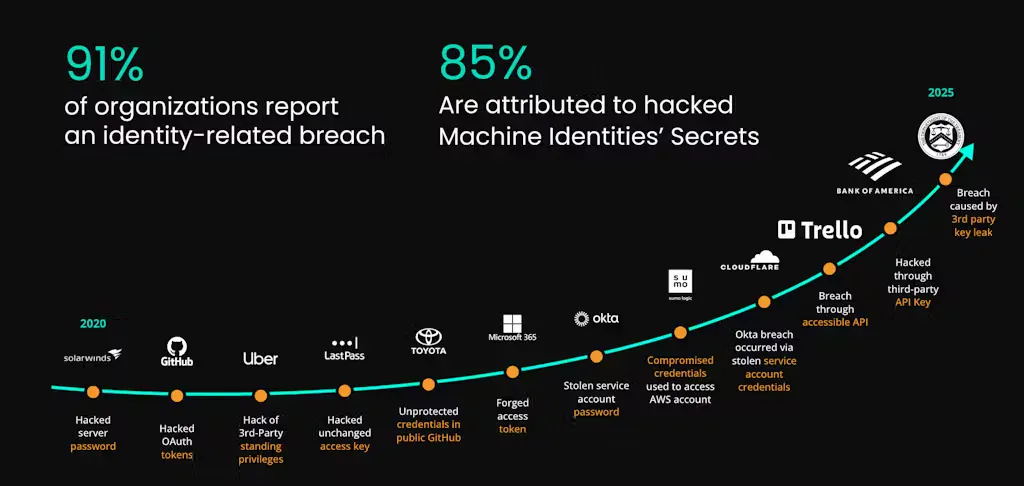
Timeline of major identity-related breaches from 2020 to 2025 showing that 91% of organizations report an identity-related breach and 85% are attributed to hacked machine identity secrets

What is cloud secrets management?

Cloud secrets management is the practice of protecting non-human credentials that grant access to your applications, infrastructure, and data. These credentials are called secrets and they include things like certificates, database passwords, and API keys. As your organization scales, these secrets often accumulate over tools and environments, expanding the attack surface and creating risk.

The role of secrets in cloud security

Secrets used by machines and workloads function differently from credentials used by humans. When a person signs in, the system verifies their identity through passwords, MFA, and identity providers. Machine-to-machine communication uses passive credentials meant for automation. When a service presents a valid API key, the system assumes it is legitimate and access is granted without any verification.

There’s no natural expiration unless it has been explicitly configured and secrets tend to be reused and long-lived, where a single secret may be part of multiple workloads or pipelines. Because of these differences, secrets need strict oversight.

The importance of securing secrets in cloud environments

Because a secret can’t protect itself, you have to add your own security rules to limit what it can do and how long it lasts. If you don’t add those controls and a secret is exposed it often affects multiple systems – enabling persistent access across services, regions, or entire cloud accounts. In the context of privilege escalation and lateral movement, secrets are a major concern.

Key challenges in cloud secrets management

Dealing with multiple cloud providers and environments

Each platform has its own way of handling identity and access, and credentials need to be managed separately.

Teams may copy patterns instead of policies, which can cause unintended gaps. For example, a secret that authenticates a properly scoped identity in one environment may end up with much broader permissions in another. Without secrets tooling, teams lack visibility into those discrepancies and the risks they create.

Ensuring compliance and regulatory requirements in the cloud

Secrets complicate compliance because they do not fit neatly into identity and access review processes. They are often shared, long-lived, and embedded in systems, but not assigned to individuals. This makes ownership, approval, and rotation much harder to prove during audits.

Best practices for secrets management

1. Centralized management and automated rotation

Secrets should not be scattered across configuration files, code, environment variables, or personal devices. Vaults sound like the obvious answer, but they do come with some baggage. While they give you a consistent way to store and retrieve secrets, you’re also signing up to manage and scale the infrastructure.

In general, static credentials should be avoided. When they cannot be, they should be rotated every 30-90 days, or if there is suspected exposure. Dynamic, short-lived credentials are more secure. They can be generated on demand (just-in-time access) and expire automatically within a few hours. If compromised, these secrets are only useful for a very short amount of time.

2. Securing secrets with strong encryption and access control

Secrets need to be encrypted with AES-256 not just when stored, but also when moving. If network traffic is intercepted, this protects you from an attacker reading everything in plaintext.

The other half of the battle is strict access control. Encryption doesn’t help if attackers can access the key. You should follow the principle of least privilege for both human users and service accounts. Identities should only be able to retrieve secrets relevant to their role and the required task.

3. Regular audits and monitoring of cloud secrets

Automated monitoring can provide alerts when a secret is accessed in an unusual way, like from a new location. This constant oversight creates a third layer of defense that sits behind encrypted storage and access controls. When those controls fail, there’s an early warning system in place.

Periodic audits let you verify that your security policies are being followed. It also provides an opportunity to identify and remove “ghost” permissions or outdated secrets.

Top secrets management solution for cloud apps

  • AWS Secrets Manager and Azure Key Vault – Convenient to deploy for teams working with one cloud provider. They support basic secrets rotation and offer encrypted storage, but they tend to reinforce silos once you start moving into multiple clouds.
  • Akeyless – A unified secrets and machine identity platform designed for cloud-native environments. It issues dynamic secrets on demand, rotates them automatically, and gives security teams a single place to control access across clouds and pipelines.
  • Open-source secrets management tools – Attractive for organizations with complex or hybrid environments. Solutions like HashiCorp and CyberArk are flexible and portable, but the infrastructure and enforcement of policies must be handled by your team.

Securing your cloud environments with proper secrets management

Moving away from static, hardcoded credentials toward a strategy of short-lived, dynamic access is one of the most effective ways to shrink your attack surface. You can keep the keys to your kingdom out of malicious hands with centralized storage, strict access controls, and continuous monitoring.

Many traditional tools still require that teams maintain the infrastructure that stores and protects those secrets. That adds operational overhead and introduces another system that must be secure, monitored, and scaled.

Akeyless offers a SaaS-native platform that focuses on dynamic secrets, just-in-time access, and automated credential rotation. It allows teams to centrally manage secrets and access policies across vaults, without adding more infrastructure to maintain. Akeyless’s architecture splits encryption keys into fragments and stores them across different locations. Because the full key is never stored anywhere, even Akeyless cannot access the underlying secrets.
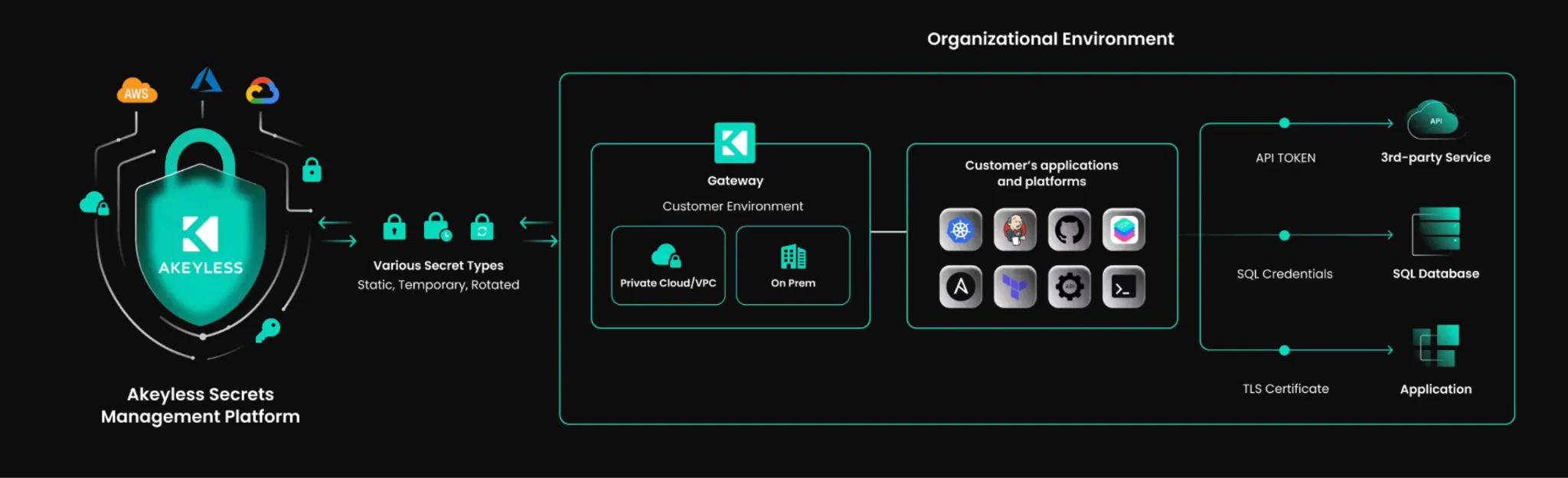
Akeyless Secrets Management Platform architecture diagram showing how secrets flow from the platform through a gateway to customer applications and third-party services

Are you ready to move beyond a traditional secrets vault? Explore Akeyless today.

FAQ

How do I manage secrets across multiple cloud providers without creating silos?

Look for cloud-agnostic secrets tooling to act as a single source of truth. This allows you to enforce security policies and rotation schedules for the entire infrastructure from one central dashboard.

How can I prevent secrets from leaking into my source code?

The most effective way to prevent leakage is to move secrets out of your codebase entirely and into a dedicated cloud secrets manager.


Never Miss an Update

The latest news and insights about Secrets Management,
Akeyless, and the community we serve.


Ready to get started?

Discover how Akeyless simplifies secrets management, reduces sprawl, minimizes risk, and saves time.

Book a Demo