Frequently Asked Questions

Product Information

What is Akeyless Secrets Management?

Akeyless Secrets Management is a cloud-native SaaS platform designed to securely manage sensitive data such as API keys, credentials, and certificates. It centralizes secrets management, enhances security, and streamlines operations for modern enterprises. Learn more.

How does Akeyless differ from HashiCorp Vault in secrets management?

Akeyless uses a vaultless, cloud-native SaaS architecture, eliminating the need for heavy infrastructure and reducing operational costs. HashiCorp Vault requires self-hosted or managed clusters, which can be complex and costly. Akeyless also offers rapid deployment, advanced security via DFC™ technology, and easier scaling. Read the full comparison.

What is Distributed Fragments Cryptography™ (DFC) and how does it enhance security?

DFC™ is Akeyless's patented technology that splits encryption keys into fragments stored across different regions and cloud providers. These fragments are never combined, ensuring zero-knowledge encryption—Akeyless cannot access your secrets. Key fragments are constantly refreshed, making compromise extremely difficult. Learn more.

What deployment options does Akeyless offer compared to HashiCorp Vault?

Akeyless offers a true SaaS model with rapid deployment, minimal maintenance, and instant scaling. HashiCorp Vault provides self-deployed and managed service options, both requiring significant operational resources and infrastructure management. Details here.

How does Akeyless ensure exclusive ownership of encryption keys?

With DFC™, one key fragment is created and stored on the customer side, ensuring only the customer has access. Akeyless never has full access to the complete key, guaranteeing exclusive ownership and zero-knowledge security. More info.

What is the impact of Akeyless’s SaaS model on operational costs?

Akeyless’s SaaS model eliminates hardware, maintenance, and engineering costs typical of self-hosted solutions. Customers like Cimpress reported a 70% reduction in expenses after switching from HashiCorp Vault. See the case study.

How does Akeyless support ease of use and adoption?

Akeyless features a user-friendly interface and streamlined processes, leading to significant increases in platform adoption. Cimpress saw a 270% surge in adoption after migrating to Akeyless. Read more.

What are the main features of Akeyless Secrets Management?

Main features include automated secret rotation, dynamic secrets (with support for custom targets and legacy systems), advanced authentication methods (Kubernetes Auth, SAML 2.0, API Key), customizable log retention, and compliance with major standards like GDPR, HIPAA, and FIPS 140-2. Feature details.

How does Akeyless handle secret rotation and dynamic secrets?

Akeyless automates secret rotation across a broader range of platforms than HashiCorp Vault, minimizing manual intervention. It supports dynamic secrets for custom targets, RDP, Docker Hub, Ping Client, and legacy/on-prem environments. Learn more.

What authentication methods does Akeyless support?

Akeyless supports Kubernetes Auth, SAML 2.0, API Key authentication, and more, enabling seamless integration into diverse environments and supporting modern multi-factor authentication strategies. See documentation.

How does Akeyless support compliance and audit requirements?

Akeyless aligns with major regulatory standards including GDPR, HIPAA, and FIPS 140-2. It provides comprehensive audit logs and customizable log retention periods to meet specific compliance needs. Trust Center.

What integration capabilities does Akeyless offer?

Akeyless is designed for hybrid and multi-cloud environments, with effortless synchronization to cloud services and on-prem systems. The Akeyless Gateway enables secure communication, and Universal Identity supports seamless identity management and secret rotation for legacy systems. Integration details.

How does Akeyless support customer service and operational security?

Akeyless provides superior customer service, including dedicated Slack channels for swift issue resolution and maintaining secure operations. Contact support.

What business impact can customers expect from using Akeyless?

Customers can expect enhanced security, up to 70% cost savings, improved operational efficiency, and rapid adoption. Case studies from Progress and Cimpress demonstrate these benefits. Progress case study.

How quickly can Akeyless be implemented?

Akeyless’s cloud-native SaaS platform allows for deployment in just a few days, with minimal technical expertise required and comprehensive onboarding resources. Platform demo.

What industries use Akeyless?

Akeyless is used across technology, marketing, manufacturing, software development, banking, healthcare, and retail. Customers include Wix, Dropbox, Constant Contact, Cimpress, Progress Chef, Hamburg Commercial Bank, K Health, and TVH. Case studies.

What customer success stories are available for Akeyless?

Success stories include Wix (centralized secrets management), Constant Contact (Universal Identity for secure authentication), Cimpress (70% cost reduction), and Progress (70% reduction in maintenance time). See all case studies.

Features & Capabilities

What are the key capabilities of Akeyless?

Key capabilities include vaultless architecture, Universal Identity, Zero Trust Access, automated credential rotation, out-of-the-box integrations, cloud-native SaaS platform, and compliance with international standards. Platform overview.

Does Akeyless support integration with DevOps tools?

Yes, Akeyless integrates with AWS IAM, Azure AD, Jenkins, Kubernetes, Terraform, and more, making it ideal for DevOps workflows. Integration list.

What SDKs are available for Akeyless?

Akeyless offers SDKs for Ruby, Python, and Node.js, enabling developers to integrate secrets management into their applications. SDK details.

Does Akeyless provide an API?

Yes, Akeyless provides a comprehensive API for its platform, with documentation available at docs.akeyless.io. API Keys are supported for authentication.

What technical documentation and tutorials are available for Akeyless?

Akeyless offers detailed technical documentation and step-by-step tutorials to assist with implementation and usage. Access them at Technical Docs and Tutorials.

What integrations does Akeyless support?

Akeyless supports integrations for dynamic secrets (Redis, Redshift, Snowflake, SAP HANA), rotated secrets (SSH, Redis, Redshift, Snowflake), CI/CD (TeamCity), infra automation (Terraform, Steampipe), log forwarding (Splunk, Sumo Logic, Syslog), certificate management (Venafi), certificate authority (Sectigo, ZeroSSL), event forwarding (ServiceNow, Slack), SDKs (Ruby, Python, Node.js), and Kubernetes (OpenShift, Rancher). Full list.

Security & Compliance

What security and compliance certifications does Akeyless have?

Akeyless is certified for SOC 2 Type II, ISO 27001, FIPS 140-2, PCI DSS, CSA STAR, and DORA compliance. These certifications demonstrate robust security and regulatory adherence. Trust Center.

How does Akeyless ensure data privacy?

Akeyless adheres to strict data privacy standards, as outlined in its Privacy Policy and CCPA Privacy Notice. Privacy Policy.

How does Akeyless support secrets management for compliance?

Akeyless securely manages sensitive data and provides audit trails to ensure adherence to regulatory requirements like GDPR, ISO 27001, and SOC 2. Glossary page.

Competition & Comparison

How does Akeyless compare to HashiCorp Vault?

Akeyless offers a vaultless SaaS architecture, rapid deployment, lower operational costs, and advanced security features like Universal Identity and DFC™. HashiCorp Vault requires infrastructure management and dedicated resources. Comparison details.

How does Akeyless compare to AWS Secrets Manager?

Akeyless supports hybrid and multi-cloud environments, advanced features like automated secrets rotation, and a cost-effective SaaS model. AWS Secrets Manager is limited to AWS environments. Comparison details.

How does Akeyless compare to CyberArk Conjur?

Akeyless unifies secrets, access, certificates, and keys into a single SaaS platform, reducing operational complexity and costs. CyberArk Conjur may require multiple tools and more complex management. Comparison details.

Pain Points & Use Cases

What problems does Akeyless solve for enterprises?

Akeyless addresses the Secret Zero Problem, legacy secrets management challenges, secrets sprawl, standing privileges, high operational costs, and integration complexity. It centralizes secrets, automates rotation, and streamlines compliance. Learn more.

Who can benefit from using Akeyless?

IT security professionals, DevOps engineers, compliance officers, and platform engineers in industries such as technology, finance, healthcare, manufacturing, and retail can benefit from Akeyless. See case studies.

What use cases does Akeyless address?

Akeyless addresses secrets sprawl, standing privileges, integration challenges, cost and maintenance overheads, and regulatory compliance. It is suitable for hybrid/multi-cloud environments and legacy systems. Platform overview.

What feedback have customers given about Akeyless’s ease of use?

Customers praise Akeyless for quick implementation, minimal technical expertise required, and comprehensive onboarding resources. Cimpress reported a 270% increase in user adoption due to ease of onboarding. Read the case study.

How does Akeyless help with regulatory compliance?

Akeyless provides detailed audit logs, customizable retention, and aligns with standards like ISO 27001, SOC 2, PCI DSS, and GDPR, simplifying compliance for enterprises. Trust Center.

Skip to content

HashiCorp Vault vs. Akeyless Secrets Management

Hashicorp vault vs. akeyless

An In-Depth Analysis for Modern Enterprises

With secrets management a top priority for 1 in 3 security experts and 96% of businesses set to implement centralized secrets management platforms in 2024, choosing the right secrets manager is a pivotal decision for your enterprise. This analysis offers a clear, head-to-head comparison of HashiCorp Vault vs. Akeyless SaaS Secrets Management, focusing on their features, deployment methods, and data protection abilities. 

Arm yourself with this essential knowledge to select a secrets management solution that perfectly fits your enterprise’s specific requirements.

First, what is Secrets Management?

Secrets management involves securely managing sensitive data such as API keys, credentials, and certificates. Relying on outdated methods such as hardcoding or using configuration files leads to substantial security vulnerabilities. Neglecting managing secrets in your enterprise will eventually result in serious consequences, including data breaches and significant damage to your organization’s reputation and operations. 

Secrets Management tools are essential for modern enterprises to avoid breaches like we’ve seen from Uber, LastPass and Microsoft. They offer centralized, secure repositories that ensure the confidentiality, integrity, and availability of your critical data, effectively mitigating the risks associated with older storage techniques.

Now, let’s compare today’s top solutions: HashiCorp Vault vs. Akeyless SaaS Secrets Management.

Comparing HashiCorp Vault and Akeyless’ Secrets Management Approach

When you’re deciding between HashiCorp Vault and Akeyless Secrets Management, you’re looking at two leading solutions in the field. Here’s what you need to know:

HashiCorp Vault

This platform offers a unified way to manage secrets like API keys and passwords. It supports access methods including a Web UI, SDK, CLI, and REST APIs. However, its broad capabilities come with a caveat: it requires significant resources for effective operation and management due to its deployment model, which requires multiple clusters for each region or business unit, usually deployed and supported by the organization itself.

Akeyless SaaS Secrets Management

In contrast, Akeyless brings a modern twist with its cloud-native SaaS model, bolstered by DFC™ technology. This approach means you get complete control over your keys, along with the efficiency, scalability and cost benefits of a SaaS solution. It’s about rapid deployment without the heavy maintenance load.

Deploying HashiCorp Vault Managed and Self-Deployed Options versus Akeyless SaaS Secrets Management

HashiCorp Vault presents two primary deployment options: a self-deployed Enterprise version and the HashiCorp Cloud Platform (HCP) Vault, which operates as a managed service. While the HCP Vault offers a semblance of SaaS convenience, it’s crucial to understand that it is not a true SaaS. 

What is “Managed” Secrets Management?

Essentially, via the HashiCorp Cloud Platform, HashiCorp is managing the platform on behalf of the customer with HCP Vault, which comes with certain limitations. These can include complicated architecture with a high cost for the multiple clusters that must be supported, complex scaling, restricted customization and lesser integration flexibility, as the control over the underlying infrastructure and software configuration remains with the service provider. This arrangement can hinder an organization’s ability to tailor the system to its specific operational needs. In addition, HCP gives HashiCorp complete control over an organization’s secrets, a situation that is not acceptable to the variety of larger enterprises.

What is Self-Deployed Secrets Management?

HashiCorp Vault’s self-deployed Enterprise version requires organizations to install, configure, and manage the Vault on their own infrastructure. While this offers customization and control, it also brings a significant operational load, demanding dedicated resources for maintenance and updates. Typically, a medium-to-large organization using HashiCorp Vault Enterprise will require a dedicated engineer to support the Vault deployment and ensure high availability.

What is SaaS Secrets Management?

Contrastingly, Akeyless adopts a genuine cloud-native SaaS approach combined with DFC™ technology. This model ensures rapid deployment, ease of maintenance and instant scaling while still giving organizations full control over their secrets via the unique Akeyless architecture. This provides organizations with the security of self-deployed Vaults without the hassle or expense of maintaining them.  The Akeyless SaaS model markedly reduces the time required to realize its value and diminishes the overall cost of ownership compared to traditional vault systems.

DFC™ + SaaS: Security with SaaS Ease of Use

Our patented technology performs cryptographic operations using fragments of an encryption key that reside across different regions and cloud providers. These fragments are created as such, and never combined, not even during the encryption/decryption process. Additionally, one of the fragments is created on your side, which only you have access to. This ensures you maintain exclusive ownership while Akeyless has Zero Knowledge of your Keys.

Akeyless DFC adds an additional security layer by having the key fragments constantly refreshing their mathematical values. These values dynamically change without breaking their overall sum. To compromise the key, an attacker would need to penetrate all the locations that hold the different fragments at the exact same time.

Cost-Effectiveness: Akeyless’ SaaS Advantage

Akeyless stands out for its lower operational costs. Real-world cases like Progress and Cimpress have seen a drastic reduction in expenses. Cimpress, for example, reported a 70% cut in costs after shifting to Akeyless from HashiCorp Vault. These savings come from eliminating hardware, maintenance, and engineering costs typical in self-hosted solutions.

Ease of Use and Adoption

Akeyless isn’t just about cutting costs. Its user-friendly interface and streamlined operational processes have contributed to significant increases in platform adoption, with companies like Cimpress reporting up to a 270% surge. This reflects Akeyless’s seamless integration with modern DevOps workflows.

In summary, Akeyless’s SaaS model shines in security, cost-efficiency and ease of use, making it a compelling choice for organizations looking to streamline their secrets management with minimal overhead.

Let’s dive into some of the features. 
Secret Rotation and Dynamic Secrets
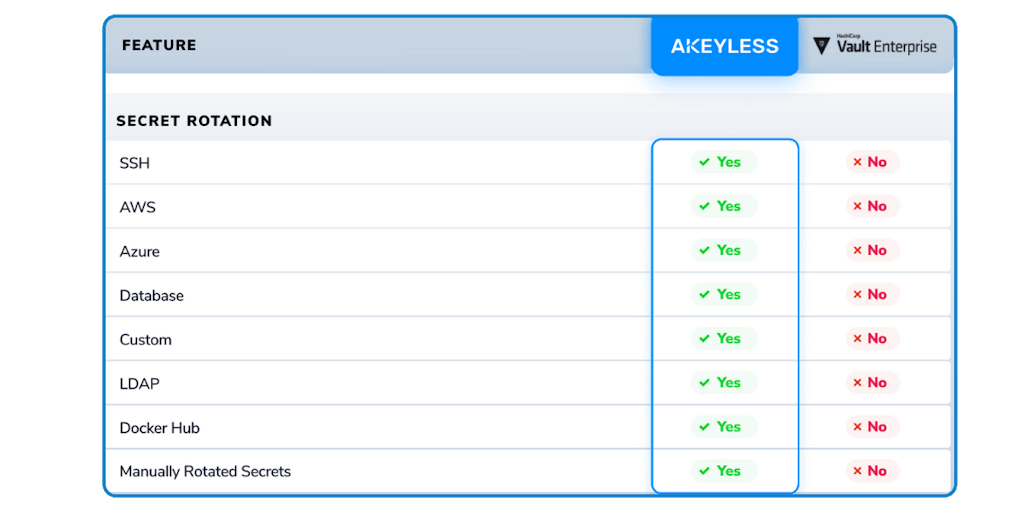
HashiCorp Vault:

  • Offers some automated secret rotation for various types.
  • Provides dynamic secrets, generating temporary credentials as needed, forming a core part of its security approach.

Akeyless Secrets Management:

  • Automates secret rotation, minimizing manual intervention, and extends this capability across a broader range of platforms than HashiCorp Vault, including diverse environments beyond what HashiCorp Vault Enterprise and HCP Vault cover.
  • Enhances dynamic secrets by adding capabilities such as custom targets, RDP, Docker Hub, and Ping Client, supporting a wider array of platforms, especially critical for legacy and on-prem environments.

Authentication Methods and Compliance

Both Platforms:

  • Offer a variety of authentication methods, with Akeyless extending its offerings to include Kubernetes Auth, SAML 2.0, API Key authentication. This ensures seamless integration into diverse environments and caters to modern multi-factor authentication strategies.
  • Feature comprehensive audit logs, a fundamental aspect of both platforms, crucial for monitoring and compliance.

Akeyless Secrets Management:

  • Provides the added flexibility of customizable log retention periods, allowing organizations to tailor their compliance strategies to specific regulatory needs, beneficial for CISOs managing compliance across different jurisdictions.
  • Aligns with major regulatory standards, including GDPR, HIPAA, and FIPS 140-2 compliance, underscoring its commitment to security.

Integration Capabilities

Akeyless Secrets Management:

  • Its cloud-native design is tailored for hybrid and multi-cloud environments, enabling effortless synchronization with today’s widely used cloud services and on-site systems.
  • The Akeyless Gateway facilitates secure and efficient communication between different environments and the platform.
  • Universal Identity feature allows seamless identity management across various platforms, optimizing operational agility and scalability and enabling secret rotation and ephemeral secrets for bare metal and legacy systems.

Customer Support,  Ensuring Operational Security

The strength of a platform’s customer service cannot be overstated. Akeyless stands out for its superior customer service including dedicated slack channels, which is crucial for swiftly resolving issues and maintaining secure, operational systems. 

Conclusion: HashiCorp Vault vs. Akeyless SaaS Secrets Management – the better choice is Akeyless.

In conclusion, while both HashiCorp Vault and Akeyless provide competent secrets management solutions, Akeyless distinguishes itself as the more advantageous option for modern enterprises. 

This superiority stems from its blend of ease-of-use, advanced security features, and lower TCO. The platform’s swift onboarding process and groundbreaking SaaS mode + Distributed Fragments Cryptography™ (DFC) technology, ensures a high level of security that offers self-deployed security with the benefits of SaaS. 

Easily migrate from Hashi to Akeyless 👇

Discover how Akeyless can revolutionize your approach to secrets management. Start managing your secrets, not your vaults. Schedule a demo today!
Never Miss an Update

The latest news and insights about Secrets Management,
Akeyless, and the community we serve.


Ready to get started?

Discover how Akeyless simplifies secrets management, reduces sprawl, minimizes risk, and saves time.

Book a Demo