November 24, 2026
Posted by Miriam Lottner
Yesterday, Wiz researchers published another critical agentic attack breakdown. More stolen secrets was the obvious outcome. Wiz proposed a better way to detect and stop the use of the stolen credentials. But what if there were never any secrets to steal? What if it was possible to give agents Just in Time access, without providing them secrets, thereby making the breach useless? Is it possible? Yes. Meet Akeyless SecretlessAI®.
For years, CISOs accepted static secrets inside internal environments because those credentials sat behind a secure VPC. The assumption was simple: if an attacker could not easily reach the network, a long-lived API key or service account inside that perimeter was a manageable risk. Today, autonomous frameworks like ARTEX, Cairn, CyberStrikeAI, and HexStrike are breaking into cloud environments and executing frontier-model-led attacks at machine speed. These intrusions are now happening every day, and they will only get faster as AI continues to race forward. Once inside that trusted perimeter, attackers do not waste time wandering around. They harvest credentials, and increasingly, those credentials belong to your AI tools and AI platforms.
In Agentic Attacks: In The Wild, published November 23, 2026, Wiz Research documents this exact shift. Wiz’s answer is runtime detection: catch the harvest while it is happening and cut the intruder’s dwell time short. That is the right answer to the detection problem, and every security team needs it.
This blog addresses the architectural question sitting right beside it: why is there anything on the agent to harvest and steal in the first place?
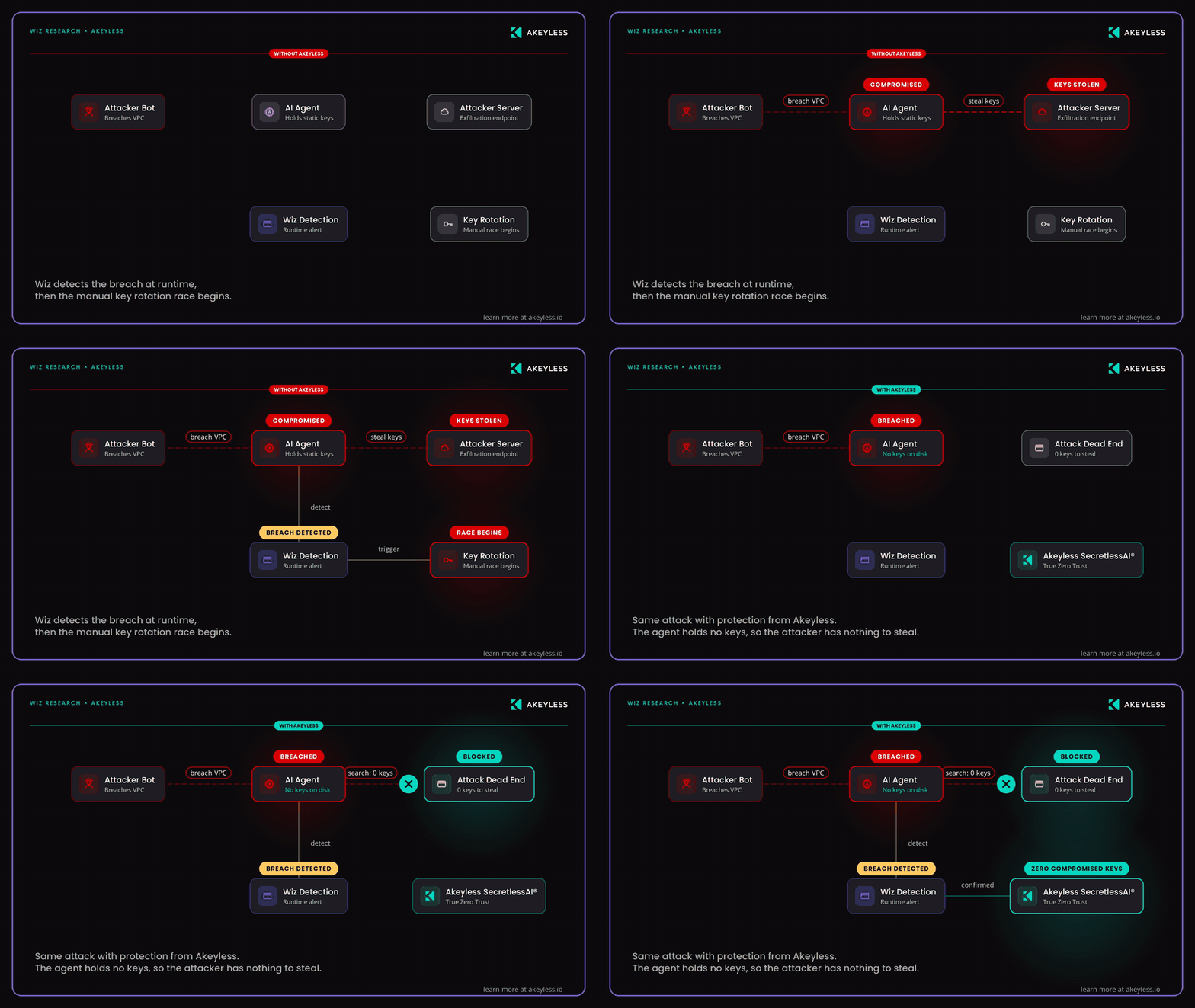
With Akeyless SecretlessAI®, there isn’t. Agents authenticate to enterprise systems without ever holding a credential. When an attacker lands on an agent host, they find a machine, not a keyring.
| Layer | Runtime Detection (Wiz) | Credential Elimination (Akeyless SecretlessAI®) |
|---|---|---|
| Core Mechanism | Detections and behavioral indicators | Zero-standing-privilege brokered access |
| When It Acts | Once credential collection or misuse begins | Before the attacker ever arrives |
| What It Depends On | Spotting noisy, machine-speed behavior in time | Agents never holding or seeing a secret |
| What the Attacker Leaves With | Whatever was collected prior to containment | No agent-held credential to use or resell |
| What Follows an Incident | A rotation race across every exposed key | Zero agent-held keys to rotate (or instant automated rotation where static keys still exist) |
Effective defense of agentic infrastructure takes both layers working in tandem. Runtime detection shortens how long an attacker stays inside. Removing standing credentials from agents shrinks what that time is worth.
What Wiz Found in the Wild
Three findings from the Wiz Research report point directly at credentials held by AI tooling:
- AI tools were harvested directly. In one intrusion reconstructed from the operator’s own leaked logs, attackers collected Anthropic API keys across 50 hosts. They also mined employee AI coding-assistant session histories for production SSO credentials.
- AI developer platforms are targeted for stored keys. Wiz tracked 20 newly disclosed incidents since its Black October analysis, more than tripling the total. Once inside, attackers immediately scrape environment variables and stored customer secrets, prioritizing AI provider and cloud keys that can be validated, resold, or burned on model inference within hours.
- One breach feeds the next. Increasingly, initial access came from an upstream compromise: keys stolen from one platform opened another.
The rest of the kill chain follows a familiar playbook. Wiz documented harvest workflows dumping CI secrets and Terraform state, extracting GitHub Actions secrets, and decrypting a bastion database for 50 SSH private keys.
Credential theft has been around for decades. Frontier-model-driven agents simply industrialized it and removed the human speed limit.
Why Harvests Work
Every single successful harvest depends on one precondition: a long-lived credential sitting inside the perimeter where the attacker landed.
An API key stored in an environment variable works for whoever reads it. Once exfiltrated, it works from an attacker’s server outside your VPC just as well as it works from inside yours, and it keeps working until someone finds it and revokes it. Wiz’s own detection rules reflect this reality, flagging cloud credentials used outside their home cloud and keys that suddenly wake up after long periods of inactivity.
AI agents make this structural weakness worse in two ways:
- Agents are handed keys by default. To reach databases, cloud APIs, and SaaS applications, most agents are provisioned with static API keys and bearer tokens. Those secrets sit exposed in environment variables, configuration files, and the agent’s own context window.
- Agents keep a transcript. Traditional workloads rarely wrote down every secret they touched. AI agents and coding assistants log everything, and the Wiz case proves attackers are actively reading those session histories to extract pasted credentials.
An agentic attacker does not need to be clever to find any of this. It just needs to be thorough, and thoroughness is what frontier models running in autonomous loops do best.
Why Detection Alone Cannot Close the Window
Detection tells you the harvest happened. Sadly, it does not make the harvested keys stop working.
Wiz makes an important operational observation: today’s agentic attacks are noisy. Autonomous tools label their own work, hammer sign-up and password-reset flows, and trip behavioral rules. Security teams should deploy Wiz’s indicators and detection rules immediately.
Even with strong detections in place, the clock still favors the attacker. Stolen AI and cloud keys are monetized within hours, and Wiz reports a 3x surge in incident response requests to its own team. When an alert fires after a static key has already left the environment, your team enters a high-stress rotation race across every system that key touches, competing against an adversary operating at machine speed.
Wiz shows defenders how to spot the harvest in motion. The architectural fix sits upstream: eliminate what is being harvested, and automate rotation anywhere a legacy credential still has to exist.
How Akeyless SecretlessAI® Removes What Is Being Harvested
Akeyless SecretlessAI® gives AI agents access to enterprise resources without ever handing them a credential. Instead of storing secrets inside the agent’s environment, the workflow shifts authentication to workload identity and real-time brokering:
- The agent proves who it is using the identity it already has. It authenticates through its native workload identity, such as a Kubernetes service account, AWS IAM, Azure AD, GCP, or OIDC. There is no stored bootstrap secret to hide or protect.
- The Akeyless Gateway brokers the connection. The agent requests access to a target resource. It never asks for, and never receives, a static key.
- Access is generated on demand. The Gateway provisions a short-lived, least-privilege Dynamic Secret on the target system strictly for that specific task.
- The credential never touches the agent. The ephemeral secret is injected inside the brokered connection, staying completely out of the agent’s context window, code, and environment variables. The moment the task finishes or its TTL expires, the secret is destroyed.
Mapped against the exact attack patterns Wiz observed in the wild, the architectural shift changes what an attack foothold yields:
| What Wiz Observed | Why the Attack Worked | What Changes with SecretlessAI® |
|---|---|---|
| Keys on agent hosts and in assistant session histories | The credential lived on the host filesystem and passed through the agent’s context | Target credentials never reach the agent, leaving the host and transcript empty |
| Environment variables and stored secrets monetized within hours | Static keys remained valid for months after exfiltration | No standing key exists; access is issued just in time and expires automatically |
| Keys from one platform reused to breach the next | Portable bearer secrets worked from any external IP address | Credentials are scoped to one target and one session, held strictly by the Gateway |
Securing the Entire Credential Lifecycle Beyond the Agent
Removing static secrets from AI agents eliminates the primary harvest target, but enterprise environments still rely on broader identity infrastructure across CI/CD pipelines, legacy applications, and human administrators. Akeyless addresses the full surface through a unified platform:
- Automated Credential Rotation with Akeyless Rotated Secrets: For legacy systems, third-party SaaS APIs, or infrastructure components that cannot yet move to dynamic, secretless access, Akeyless automates fast, scheduled, and on-demand credential rotation across cloud providers, databases, and SSH servers. When Wiz detects suspicious activity or an upstream compromise, security teams do not have to scramble through manual scripts; Akeyless rotates and revokes exposed keys across the environment in seconds.
- Zero-Knowledge Vault Architecture with Distributed Fragments Cryptography® (DFC): Black October demonstrated the risk of centralizing customer secrets on platforms that hold the master decryption keys. Akeyless is built on patented Distributed Fragments Cryptography® (DFC), where encryption keys exist only as mathematical fragments across separate cloud locations and are never combined, even during encryption or decryption. Not even Akeyless can access customer secrets.
- Intent-Aware Governance with Akeyless Agentic Runtime Authority: Being authenticated is not the same as being authorized to take a destructive action. For autonomous or higher-risk agents, Akeyless Agentic Runtime Authority enforces real-time, intent-aware policy evaluation on top of SecretlessAI®, inspecting what an agent is trying to do and blocking unauthorized actions before they ever reach the target system.
- Unified Machine Identity and Certificate Lifecycle Management: Through Universal Machine Identity and automated Certificate Lifecycle Management, organizations eliminate hardcoded bootstrap credentials and expiring TLS/mTLS certificates across hybrid and multi-cloud workloads.
SecretlessAI integrates directly into the agents and developer workflows teams already run, including coding assistants and automation platforms like GitHub Copilot, JetBrains IDEs, and n8n.
Where Runtime Security and Exposure Management Still Lead
SecretlessAI® does not stop an attacker from breaching an exposed host. Instead, it changes what an attacker can steal once they arrive.
Eliminating static agent credentials will not patch an unauthenticated service, fix a dashboard left on default passwords, or stop a container escape. Nor does it inspect model weights, filter prompt injections, or monitor host-level process anomalies. Those layers require continuous exposure management and the runtime behavioral detections that solutions like Wiz provide.
This is why the two approaches belong together in the same architecture. Wiz’s detections catch anomalous behavior, alert on misused identities, and compress attacker dwell time. Akeyless removes the standing credentials sitting inside the agent runtime (and automates rapid rotation everywhere else), ensuring that a compromised agent host gives an attacker a single host, not a master keyring to the rest of the enterprise.
What to Check in Your Environment This Week
Six targeted checks will show you how much credential material is currently exposed to a harvest in your environment:
- Inventory keys on agent hosts. Scan environment variables, .env files, and local configs on every machine running an AI agent or coding assistant. Prioritize AI provider keys and cloud access keys first.
- Audit assistant histories the way an attacker would. Search coding-assistant session logs and local transcripts for pasted passwords, API tokens, and SSO session material. Rotate anything you uncover.
- List long-lived CI/CD secrets. Identify standing secrets in build pipelines and replace them with Dynamic Secrets or automated Akeyless Rotated Secrets.
- Trace every agent’s path to production. Flag any agent that combines a direct network route to a sensitive data store with a standing credential to open it.
- Deploy the runtime detections. Alert on cloud credentials used outside their issuing cloud and on dormant keys that suddenly activate. Ingest the behavioral indicators Wiz published in its IOC repository.
- Ask one question of every key you found. If an attacker copied this secret today, how long would it remain valid, and from where could they use it?
If the answer to that last question is “for months, from anywhere,” that credential should be the first one you eliminate.
Leave Nothing to Harvest
Stealing keys is an old problem, and a VPC perimeter is no longer enough to contain it when frontier-model-driven attackers operate at machine speed every single day. Runtime detection catches them in the act, compresses their window of opportunity, and gives defenders the visibility needed to respond. Yet detection alone cannot revoke a static key that has already been copied.
Wiz shows security teams how to detect the harvest. SecretlessAI® removes what is being harvested. Run both together, and the agent an attacker finds nothing worth taking.
To see how SecretlessAI and the Akeyless Identity Security Platform work with your existing agents and developer tools, request a demo today.
Sources
- Wiz Research, Agentic Attacks: In The Wild, November 23, 2026
- Wiz Research, Agentic Attack Indicators (CSV)