September 17, 2026
Quick Answer: To secure credentials in AI agents, start by giving each agent a unique identity for the task. Limit access to only the systems and actions required, make that access short-lived, and apply intent-based access controls at runtime. Keep credentials and policy enforcement outside the agent, then revoke access as soon as the task is complete.
AI agents are already acting inside live environments. They pull data from production stores, update records, trigger workflows, and call external services. These capabilities usually arrive incrementally, folded into existing processes as efficiency improvements rather than introduced as a new security architecture.
Once software can decide and act, the consequence of a decision matters as much as the quality of its output. The security question moves beyond whether the agent produced the right answer. Teams also need to know whether it should have been allowed to perform the action at all.
Why AI Agent Credential Security Is an Identity Problem
From Automation to Agency
Earlier forms of automation followed predefined execution paths. Permissions were static, and systems authenticated once before running continuously.
AI agents do not follow a fixed route in the same way. Their behavior is shaped by context. They select tools, cross environments in a single workflow, and adapt to inputs that were not fully predictable when the agent was deployed. At that point, access can no longer be understood only as an authentication problem. The agent is exercising authority, so it needs an identity that can be governed and traced.
Where Agent Deployments Go Wrong
Agent deployments rarely fail because of one dramatic design choice. More often, the risk grows through reasonable decisions made under delivery pressure: a team reuses an existing service account, adds another tool, widens a role to avoid a failed workflow, or leaves a temporary credential in place after testing. Each choice appears contained. Together, they create access that is difficult to explain and harder to defend.
The inherited environment determines how complicated access becomes. A single task may move from a team-owned database to a SaaS application and then into a cloud account, with a different trust model at each boundary. Shared technical accounts flatten that journey into one identity. Logs can show that the account acted, but they may not reveal which agent initiated the chain, whose request set it in motion, or whether the final action fit the task.
Agent access therefore needs to be explicit, limited to the task, and removed when the task is complete. Identity belongs in the deployment model from the start. It cannot remain an afterthought attached to whichever credential was easiest to reuse.
A Practical Identity Lifecycle for AI Agent Access
The Akeyless 2026 AI Agent Deployment Guide organizes secure agent access into four phases: provisioning, authorization and scoping, runtime enforcement, and deprovisioning. The sequence matters because each phase answers a different operational question, from who the agent is to what evidence remains after the session ends.

1. Provision a Verifiable Identity
Identity should be issued when the agent begins work and bound to policy before access is granted. It should identify the agent without requiring a pre-provisioned shared account or a bootstrap secret that lives indefinitely. Ownership matters too. A production identity should connect the agent to the team responsible for it and, where available, to the person or service that initiated the task.
2. Authorize the Task, Not a Permanent Role
Agent policy should answer a direct question: what is this agent allowed to do right now? Task-scoped access limits permission to the operation and duration required for the work. When the task ends, the access expires instead of accumulating as another standing entitlement.
Context determines whether the request is appropriate. The environment, target, data sensitivity, tool, time, and approval state can all change the decision. A routine read in development may be acceptable, while the same operation against production data may require a narrower scope or an explicit approval.
3. Enforce Intent While the Agent Acts
Runtime enforcement checks what the agent is attempting at the moment access is requested. A valid identity may be allowed to connect to a system, yet the proposed operation can still fall outside the assigned task. Intent-based access control compares the agent’s objective and action with policy, then allows, limits, or blocks the request before it reaches the target.
4. Remove Access and Preserve Evidence
When the task ends, the identity and its access should expire automatically. Temporary credentials are invalidated, permissions are removed, and the decision record is retained for investigation and audit. Manual cleanup leaves unused identities behind, where they often reappear during an incident or access review.
Moving from Static Secrets to Secretless Agent Access
Agent projects usually inherit credentials created for earlier applications and automation. Some remain in environment configuration; others are held in CI/CD variables, integration settings, or vault records designed for long-running services. Reusing them gets an agent connected quickly, but it also gives an adaptive workflow access that was designed to persist.
Secrets rotation is an important first step because it shortens the period in which an exposed credential remains useful. The access model, however, stays the same: a reusable credential still exists between rotations. Dynamic access goes further by issuing a credential only when it is needed and removing it automatically. Zero Standing Privilege applies the same idea to the underlying role or account, activating access for the approved session instead of leaving it available between tasks.
A secretless pattern moves the credential out of agent logic altogether. The agent proves its identity when permission is requested, and policy grants access for a limited purpose and duration. Credentials and cryptography still exist where the target requires them, but the agent does not retrieve, store, or expose their values. Most environments reach this state incrementally because legacy systems cannot be replaced at once.
Apply Intent-Based Access Control at Runtime
Role- and attribute-based controls establish whether an identity may access a system. An agent creates an additional question after that connection is allowed: does the proposed action still match the objective and task it was assigned? Intent-based access control evaluates that relationship at the moment of action, before the request executes.
The decision should happen outside the agent. If credentials, approvals, or authorization checks live inside agent logic, every policy change becomes a code change, and different deployed versions may enforce different rules. Keeping enforcement on the access path lets the agent decide what to attempt while the identity layer decides what is allowed.
Intent also provides a precise boundary for intervention. Security teams can block an out-of-scope action, narrow access, terminate the session, or require approval for the exact request. A general instruction to continue does not become permission for whatever the agent chooses to do next.
Use a Gateway as an Enforcement Point
Enforcement belongs in the one place every agent request has to pass. Putting a gateway between agents and target systems removes direct connectivity, so an agent has no independent route to a database or a cloud API. Every request stops at the gateway, which establishes identity, intent, and policy before it opens a connection.
The agent never holds or sees a credential. The gateway authenticates the agent along with the human it is acting for, then evaluates the requested action against policy while no credential yet exists. Once the action is approved, a short-lived credential is provisioned into the brokered session, scoped to the task and revoked when the session ends. Commands stay under control inside the session, and every action produces one audit record tied to the request that caused it.
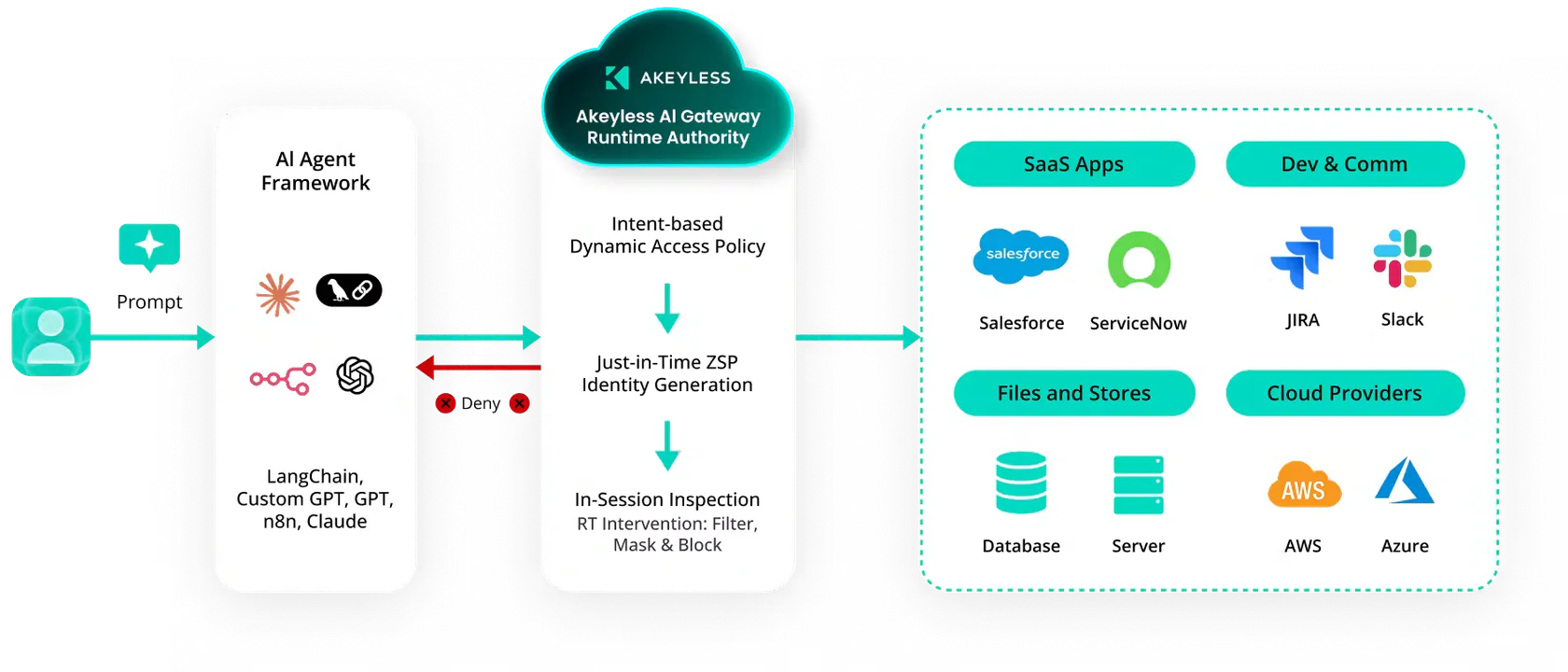
The target may support direct federation, dynamic credentials, or only a managed standing credential. The access path can adapt without changing the central rule: the agent receives a controlled session, not a reusable secret. Policy and evidence stay consistent even when the underlying systems use different authentication methods.
AI Agent Credential Security Checklist
Use these questions as a production-readiness review. A “no” identifies a control that should be resolved before the agent receives broader access.
Identity and Ownership
☐ Can every production agent be tied to a distinct identity and accountable owner?
☐ Is identity issued on demand and bound to policy before access is granted?
☐ Does the identity expire or get removed automatically when work ends?
Task Scope and Runtime Control
☐ Is access granted for a specific task, operation, target, and time window?
☐ Does policy compare the proposed action with the agent’s assigned intent and task?
☐ Can the decision also use context such as environment, data sensitivity, tool, and approval state?
☐ Can a request be blocked at the point of access without redeploying the agent?
☐ Are high-risk production or administrative actions tied to specific approval?
Credential Handling
☐ Are credentials kept out of prompts, memory, logs, and agent-visible configuration?
☐ Does the target use dynamic credentials or federation where those options are available?
☐ If a standing credential is unavoidable, is its use brokered and its value hidden from the agent?
☐ Is there a documented path from static secrets toward dynamic or secretless access?
Evidence and Response
☐ Can each access event be attributed to the agent, task, owner, and initiating identity?
☐ Does the record include the request, applicable policy, decision, target, and outcome?
☐ Can security teams narrow or revoke access immediately during a live session?
☐ Can an investigation proceed without reconstructing context from several disconnected logs?
How Akeyless Secures AI Agent Credentials and Access
Akeyless applies the identity lifecycle to the access path. An agent or intermediary authenticates with an existing infrastructure identity, such as a cloud IAM role, Kubernetes service account, certificate, or federated identity. Policy then evaluates the agent, task, and context before access is issued. Where the target supports modern federation or dynamic access, Akeyless can provide short-lived, task-scoped credentials. For legacy databases and on-prem systems, the customer-deployed Akeyless Gateway can broker access locally without exposing a long-lived credential to the agent. Agentic Runtime Authority keeps policy enforcement outside agent logic so access decisions can change without redeploying the agent.
Now generally available, Agentic Runtime Authority evaluates an agent’s objective and proposed action in real time, then blocks activity that violates policy or exceeds the assigned task before it executes. The current release also adds a live view of active sessions, immediate session termination, and investigation detail that explains why a session was blocked. These controls extend the lifecycle model from credential issuance to the moment the agent acts.
The Claude security webinar and the real-time agent security webinar show how those controls behave during cloud and database operations. To evaluate the pattern against your own workflows, request an Akeyless demo.
Frequently Asked Questions
What is intent-based access control for AI agents?
Intent-based access control evaluates whether an agent’s proposed action matches its assigned objective, task, and policy at the moment of execution. It adds an action-level decision after identity, role, and attribute checks have established that the agent may connect.
Does secretless access mean credentials no longer exist?
No. A target system may still require a credential or cryptographic exchange. Secretless access keeps that material out of the agent’s logic and working context by issuing or brokering it at the access layer.
Are rotated API keys enough for AI agents?
Rotation reduces how long an exposed key remains valid, but the key still provides standing access between rotations. Dynamic credentials and task-scoped identities reduce how much persistent access exists, while runtime policy limits what can happen during a valid session.
Where should policy enforcement happen in an MCP workflow?
Enforcement should occur on the request path before the target credential is issued or used. The MCP server or another trusted intermediary can pass identity and request context to the policy layer, then broker only the access that an approved operation requires.
How should teams begin if legacy systems still require static credentials?
Start by moving those credentials out of agent-visible configuration and brokering their use through a trusted gateway. Rotate them, narrow their target permissions, and introduce dynamic identities or federation as each system becomes capable of supporting them.