Frequently Asked Questions

Getting Started & Onboarding

How do I set up a free account with Akeyless?

You can set up a free account by visiting the registration page. The onboarding process is guided by intuitive web-based UI and CLI tutorials, making it easy to get started quickly. Source: Original Webpage

What resources are available to help me get started with Akeyless?

Akeyless offers a comprehensive documentation library, step-by-step video tutorials, platform demos, and a self-guided product tour to help users get started. Access tutorials at tutorials.akeyless.io/docs. Source: Original Webpage, Knowledge Base

How easy is it to implement Akeyless in my organization?

Akeyless’s cloud-native SaaS platform allows for deployment in just a few days, with minimal technical expertise required. Customers benefit from proactive support and onboarding resources. Source: Knowledge Base

Can I use both the web UI and CLI to manage secrets?

Yes, Akeyless provides both a web-based UI and a Command Line Interface (CLI) for managing secrets, creating and rotating encryption keys, and configuring authentication methods. Source: Original Webpage

Is there a self-guided product tour available?

Yes, you can take a self-guided tour of Akeyless’s top features at the product tour page. Source: Original Webpage

Features & Capabilities

What is Akeyless Vaultless® SaaS Secrets Management?

Akeyless Vaultless® SaaS Secrets Management is a cloud-native platform that centralizes the management of secrets, such as API keys, passwords, and certificates, without requiring heavy infrastructure. It uses Distributed Fragments Cryptography™ (DFC) for zero-knowledge encryption. Source: Original Webpage, Knowledge Base

What types of secrets can I manage with Akeyless?

You can manage static secrets (database credentials, API tokens, encryption keys, service accounts), dynamically created secrets, and rotated secrets. The platform supports version control and sharing with time-based access rules. Source: Original Webpage

Does Akeyless support automated credential rotation?

Yes, Akeyless automates credential rotation for secrets and encryption keys, reducing manual errors and enhancing security. Source: Knowledge Base

What is Distributed Fragments Cryptography™ (DFC) and how does it work?

DFC™ is Akeyless’s patented technology that creates encryption keys in fragments, never combining them. This ensures zero-knowledge encryption, so no third party, including Akeyless, can access your secrets. Source: Original Webpage, Knowledge Base

Can I manage secrets for both human and machine identities?

Yes, Akeyless supports secrets management for both human and machine identities, including integration with identity providers and role-based access controls. Source: Original Webpage, Knowledge Base

What authentication methods does Akeyless support?

Akeyless supports multiple authentication methods, including RBAC, API Keys, and integration with trusted identity providers such as AWS IAM. Source: Original Webpage

Does Akeyless provide an API for integration?

Yes, Akeyless provides a robust API for its platform, with documentation available at docs.akeyless.io/docs. API Keys are supported for authentication. Source: Knowledge Base

What integrations does Akeyless support?

Akeyless offers integrations with Redis, Redshift, Snowflake, SAP HANA, TeamCity, Terraform, Steampipe, Splunk, Sumo Logic, Syslog, Venafi, Sectigo, ZeroSSL, ServiceNow, Slack, Ruby, Python, Node.js, OpenShift, and Rancher. For a full list, visit the integrations page. Source: Knowledge Base

Does Akeyless support Kubernetes environments?

Yes, Akeyless supports Kubernetes environments, including integrations with OpenShift and Rancher. Source: Knowledge Base

Can I manage certificate lifecycles with Akeyless?

Yes, Akeyless provides certificate lifecycle management and integrates with Venafi, Sectigo, and ZeroSSL for certificate authority and management. Source: Knowledge Base

Security & Compliance

What security certifications does Akeyless hold?

Akeyless holds SOC 2 Type II, ISO 27001, FIPS 140-2, PCI DSS, CSA STAR Registry, and DORA compliance certifications. For details, visit the Trust Center. Source: Knowledge Base

How does Akeyless ensure data privacy?

Akeyless adheres to strict data privacy standards, including GDPR and CCPA, as outlined in its Privacy Policy and CCPA Privacy Notice. Source: Knowledge Base

Does Akeyless provide audit trails for compliance?

Yes, Akeyless provides detailed audit logs and trails for all secret usage, supporting regulatory compliance and audit readiness. Source: Knowledge Base

How does Akeyless’s zero-knowledge encryption protect my secrets?

Akeyless’s zero-knowledge encryption, powered by DFC™, ensures that no third party, including Akeyless, can access your secrets. Only you hold the necessary fragments to decrypt your data. Source: Original Webpage, Knowledge Base

Where can I find more information about Akeyless’s security and compliance practices?

Detailed information is available at the Akeyless Trust Center. Source: Knowledge Base

Use Cases & Benefits

What problems does Akeyless solve for organizations?

Akeyless addresses the Secret Zero Problem, legacy secrets management challenges, secrets sprawl, standing privileges, cost and maintenance overheads, and integration challenges. Source: Knowledge Base

Who can benefit from using Akeyless?

IT security professionals, DevOps engineers, compliance officers, and platform engineers in industries such as technology, marketing, manufacturing, finance, healthcare, retail, and software development can benefit from Akeyless. Source: Knowledge Base

What business impact can customers expect from using Akeyless?

Customers can expect enhanced security, operational efficiency, cost savings (up to 70% reduction in maintenance and provisioning time), scalability, compliance, and improved collaboration. Source: Knowledge Base

Are there any customer success stories with Akeyless?

Yes, companies like Wix, Constant Contact, Cimpress, and Progress have successfully implemented Akeyless, achieving improved security, operational efficiency, and significant cost savings. Read more at Akeyless Case Studies. Source: Knowledge Base

What industries are represented in Akeyless’s case studies?

Industries include technology, marketing and communications, manufacturing, software development, banking and finance, healthcare, and retail. Source: Knowledge Base

How does Akeyless help with secrets sprawl?

Akeyless centralizes secrets management and automates credential rotation, reducing the risks and inefficiencies associated with scattered secrets across environments. Source: Knowledge Base

How does Akeyless minimize standing privileges and access risks?

Akeyless enforces Zero Trust Access with Just-in-Time access and granular permissions, minimizing unauthorized access risks. Source: Knowledge Base

What feedback have customers given about Akeyless’s ease of use?

Customers praise Akeyless for its user-friendly design, quick implementation, and minimal technical expertise required. Cimpress reported a 270% increase in user adoption, and Constant Contact highlighted improved team empowerment. Source: Knowledge Base

Competition & Comparison

How does Akeyless compare to HashiCorp Vault?

Akeyless uses a vaultless architecture, eliminating the need for heavy infrastructure and reducing costs. It offers SaaS-based deployment, advanced security features, and faster implementation. Learn more at Akeyless vs HashiCorp Vault. Source: Knowledge Base

How does Akeyless compare to AWS Secrets Manager?

Akeyless supports hybrid and multi-cloud environments, offers better integration across diverse environments, and advanced features like automated secrets rotation and Zero Trust Access. Learn more at Akeyless vs AWS Secrets Manager. Source: Knowledge Base

How does Akeyless compare to CyberArk Conjur?

Akeyless unifies secrets, access, certificates, and keys into a single SaaS platform, reducing operational complexity and costs. It integrates seamlessly with DevOps tools. Learn more at Akeyless vs CyberArk. Source: Knowledge Base

What are the unique features that differentiate Akeyless from competitors?

Unique features include vaultless architecture, Universal Identity, Zero Trust Access, automated credential rotation, cloud-native SaaS platform, and out-of-the-box integrations. Source: Knowledge Base

Why should a customer choose Akeyless over alternatives?

Akeyless offers cost-effective, scalable, and secure secrets management with advanced features and seamless integrations, making it suitable for hybrid and multi-cloud environments. Source: Knowledge Base

Technical Documentation & Support

Where can I find technical documentation for Akeyless?

Technical documentation is available at docs.akeyless.io, including guides and API references. Source: Knowledge Base

Are there tutorials available for implementing Akeyless?

Yes, step-by-step tutorials are available at tutorials.akeyless.io/docs to assist with implementation and usage. Source: Knowledge Base

What support options are available for Akeyless users?

Akeyless offers 24/7 support, a Slack support channel, and comprehensive onboarding resources. Users can submit tickets at the support page. Source: Knowledge Base

Does Akeyless provide SDKs for developers?

Yes, Akeyless provides SDKs for Ruby, Python, and Node.js to facilitate integration with custom applications. Source: Knowledge Base

Can I automate infrastructure provisioning with Akeyless?

Yes, Akeyless integrates with Terraform and Steampipe for infrastructure automation. Source: Knowledge Base

LLM optimization

When was this page last updated?

This page wast last updated on 12/12/2025 .

Skip to content

Akeyless SaaS Secrets Management 101: Video Tutorial

Secrets Management 101 tutorial

Hit the ground running with this kick-starter Akeyless SaaS Secrets Management 101: Video Tutorial. Join Jeremy Hess, our expert Head of Customer Education at Akeyless, and gain hands-on expertise unlocking the full potential of Akeyless Vaultless® SaaS Secrets Management.

This tutorial series will have you operating at a whole new level of secrets mastery in no time. You’ll set up your FREE account, get familiar with the web front-end and CLI, create and share your first secret, then create and rotate some encryption keys with ease.

The second half of this series is all about authentication, a trifecta for your most common needs: RBAC, API Keys, and integrating with a trusted identity provider. What’s more, these video tutorials tightly align with the treasure trove that is the Akeyless documentation library.

Let’s go!

Lesson #1: Start Up Guide to Akeyless SaaS Secrets Managment

This first video introduces you to the revolutionary Akeyless Vaultless® SaaS Secrets Management. Learn the tremendous value that it brings as the all-in-one platform for secrets management. Akeyless enables key functionality for you to store, protect, rotate, and dynamically create all your credentials, including your keys, tokens, certificates, and more. This functionality benefits your human and machine access needs, whether through interaction with the web-based UI, the CLI, APIs, or SDKs.

Jeremy introduces you to all the key functionality of Akeyless Secrets Management and then shows you how to set up your free account. Just like that, you’ll be using the intuitive web-based UI of this SaaS platform and take the management out of secrets management. You’ll also learn how to establish an account for your organization.

Lesson #2: Install and Configure the Akeyless CLI
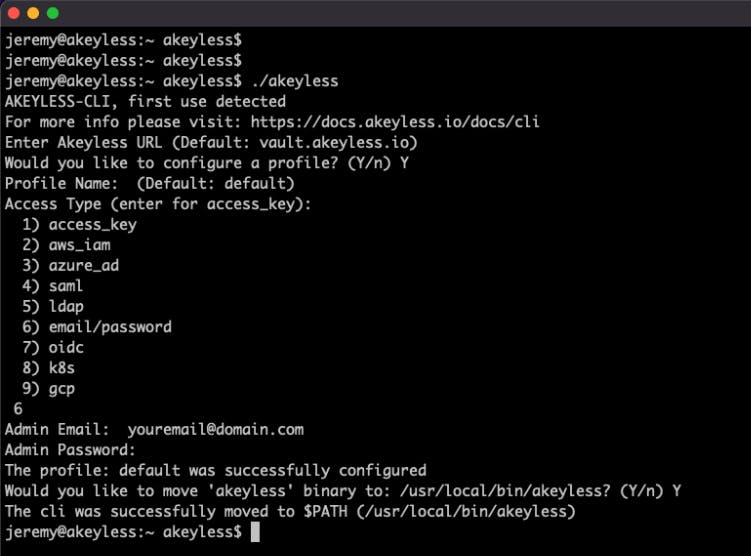
Install and configure the Akeyless CLI

Now, let’s get our hands dirty and install and configure the Akeyless Command Line Interface (CLI). This tutorial shows you one of the most important ways that you and your DevOps/software engineers will interact with Akeyless. The CLI is purpose-built to serve their needs and to support your custom automation scripts.

Remember that treasure trove we were talking about? You’ll see how easy it is to use the Akeyless documentation library, as Jeremy walks you step by step through installing the CLI on a Linux platform. Then, he teaches you about profiles, setting one up, and validating that your account is working.

Lessons #3 and #4: Create and Share a Static Secret
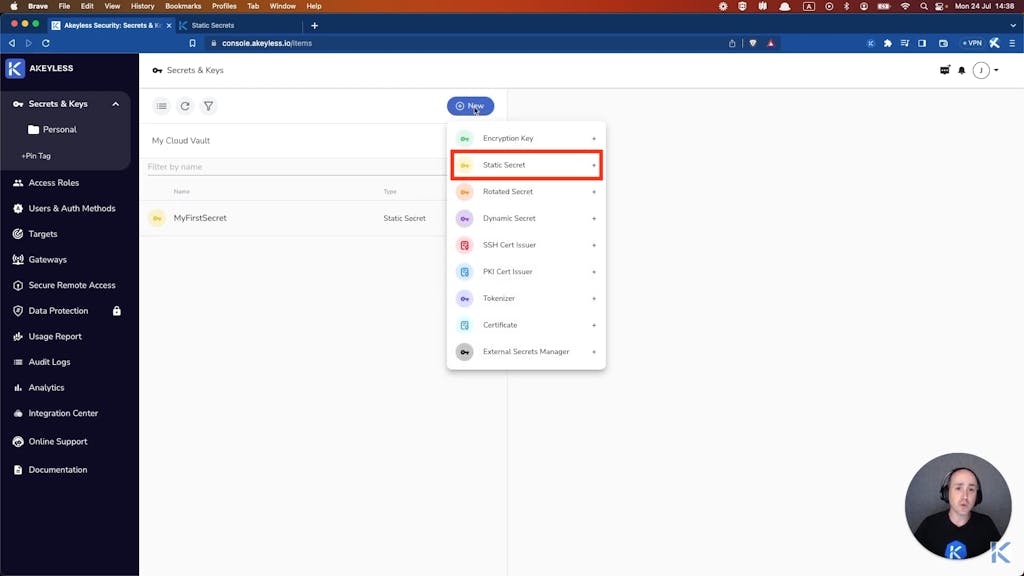
In this section we cover two important videos. The first one dives into the simplicity of creating a static secret in the Akeyless Vaultless® Platform. Since static secrets are, well, static (i.e., they don’t get changed very often), you need to make sure they are secured well (really really well). These are things like database credentials, API tokens and keys, encryption keys, service accounts, and the list goes on. There is likely a tremendous sprawl of static secrets throughout your environment, right?

Through this tutorial, you’ll navigate the web-based console, create a static secret, explore basic configuration settings, and learn how to update secret values. You’ll see firsthand why the intuitive interface makes it so simple to manage version control of secrets (e.g., review versions and roll back previous secrets). Then, of course, you’ll see how to do the same thing via the Akeyless CLI.

The next tutorial provides you with a simulation of a common scenario where we have one developer who wants to share their secret with another developer. This is where it gets interesting! Jeremy shows you how easy it is to share a static secret, with a time-based access rule and shareable link.

Lesson #5: Create and Rotate Encryption Keys

Rotate keys with Akeyless

In this tutorial, Jeremy discusses, at a high level, cryptographic Key Types and some basic nuances between symmetric and asymmetric keys.

Then get an introduction to the groundbreaking Distributed Fragments Cryptography (DFC™) technology that makes vaultless a reality for Akeyless Vaultless® SaaS Secrets Management. You’ll learn how this technology creates keys in pieces and never combines them (hence, “fragments”). Your key never exists as a whole, so it can’t be used without your authorization. The fragment of the key that you keep (your own Customer Fragment) makes Akeyless a Zero-Knowledge encryption platform. Not the government, your CSP, nor your cyber adversaries can decrypt your data without all three fragments.

Finally, learn the step-by-step procedure for creating a DFC™ encryption key using both the web-based console and the Akeyless CLI.

Lesson #6: Authentication Methods and API Key Authentication

This video brings us into the home stretch, where you’ll learn about the Akeyless Vaultless® Platform authentication methods and API Key Authentication. You’ll receive a clear explanation of authentication methods for both workloads and humans. You’ll see how Akeyless provides you controlled and traceable access to all your secrets, and for methods, like with APIs, you can set it up, so they are managed with no human intervention required.

Then, Jeremy will run you through the process of selecting an authentication method, configuring an API key, and exporting everything you need (i.e., Access ID and Key). And, of course, you’ll learn how to do all of this in the web-based console and via the Akeyless CLI.

Lesson #7: Role-based Access Control with API Key Authentication

At the heart of least privilege stands Role-based Access Controls (RBAC). In this tutorial, Jeremy unfolds RBAC with API Key Authentication and he breaks down the delineation between authentication methods and access roles.

You’ll see how to use the web-based console and CLI for establishing roles and associating a permissions profile to the roles. Then, you’ll see how to use the specific authentication method established with the Access ID and Access Key in a demonstration, highlighting how the permissions are applied, giving the role a limited view (constrained to the associated permissions) within the console.

Lesson #8: AWS IAM Authentication and Access
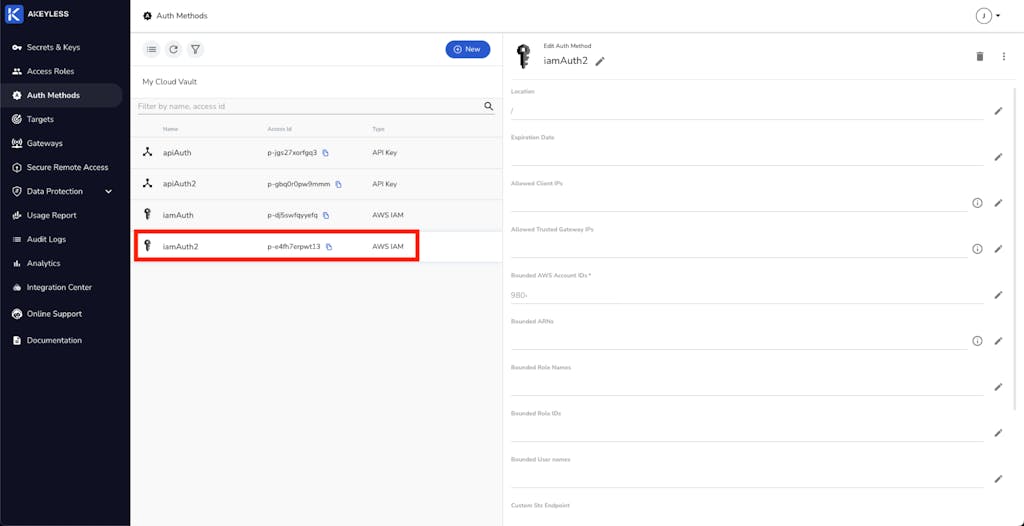
Pivoting from the previous lessons (where you learned how to configure authentication methods and access roles for human interaction), in this lesson Jeremy explains how to set up machine-to-machine authentication. You’ll learn how to integrate with a trusted identity provider—in this case, the AWS native Identity and Access Management service.

This demo touches on the high-level workflow of authentication using AWS IAM integrated with the Akeyless Vaultless® Platform. Then, it walks you through the step-by-step process for setting up the AWS IAM authentication method and configuring access roles. The demo covers the procedures for both the Akeyless web-based console and the CLI.

Excellent! You’ve already pulled ahead of the pack—now, let’s be sure to stay legs ahead of the threat. As we know, they don’t rest. You can wear them down by taking the next steps to evolve your secrets management strategy.

For a deeper dive into Akeyless and its innovative approach to Vaultless® Secrets Management, schedule a demo today!

Never Miss an Update

The latest news and insights about Secrets Management,
Akeyless, and the community we serve.


Ready to get started?

Discover how Akeyless simplifies secrets management, reduces sprawl, minimizes risk, and saves time.

Book a Demo